Saturday, 21 June 2014

Hear Ye, Hear Ye!

When one becomes a Christian, it's part and parcel to share that news with the world. We are told we should not hide our light under a bushel but shine it on a hill. 'If you deny Me on earth, I will deny you before My Father in heaven.' (Matthew 10:33) Sharing our newfound faith is an important part of becoming a Christian. Baptism follows, which (varying degrees of significance amongst denominations aside) is a commanded public pronouncement of faith. If one were to become a Christian and keep it to oneself, there would be much speculation on the sincerity of that transformation.

However, when one leaves the Christian faith, it is something to be hidden. It is scandalous. It is in some cases jeopardous, even dangerous. In a Christian society, leaving the faith is most definitely NOT something to shout from the rooftops. While Christians would praise a Muslim for bravely coming out as Christian to his or her family (thereby likely being disowned, if not downright in danger of death), they cannot conceive of a Christian coming out as Muslim, or Jewish, or even Mormon, or -gasp- atheist, and why that person would want to share that terrible news with the world.

So I hide.

More than anything I want to announce to the world that I am atheist. I want to finally get it out in the open, so I don't have to hide who I really am anymore. I don't have any ulterior motive; I'm not out to change you or persecute you. I just want to be free. I want to be known.

But I'm afraid.

I'm afraid of losing friends.

I'm afraid of losing family.

I'm afraid of losing my job.

I'm afraid of losing clients.

I'm afraid of hurting my family.

I'm afraid of humiliating my family.

I'm afraid of putting my children at risk of bullying.

I'm afraid of putting my children at risk of proselytizing.

So I hide.

It is shameful that in a country that was literally founded on people seeking religious freedom, people are not allowed to be free from religion. Religious freedom was not set aside for Christians exclusively. It was intended for all religious people - and non-religious too - whether their beliefs were Muslim, Hindu, Jewish, Buddhist or Baptist. Or atheist.

But the reality of it is, if you are not Christian - at least here in the Bible Belt - you are at risk. If you leave Christianity, you are an apostate - which is sometimes worse than being Muslim or Hindu (and therefore 'simply a part of your culture'). You may be seen as actually disgracing your family and bringing shame upon their religion... not unlike the Muslim who leaves Islam.

When I first spoke out against my church (still then a Christian), I was reproached for 'giving Christianity a bad name'. Many people felt what I had done was only further non-Christians dislike for Christianity. While I saw their point, I also saw the other side of it. Hiding the faults of churches furthers the non-Christian dislike for Christianity too, perhaps more so.

Apostatizing is perhaps the worst thing a Christian can do. It gives the religion a bad name. It gives non-Christians more ammunition. It lends credence to the possibility that Christianity is not the only answer.

Worse than anything, it waters the seeds of their own doubt that Christians don't want watered.


When I became a Christian (or rather, 'rededicated my life'), I told everyone. I didn't want to hide it from anyone. Even in situations that felt awkward, where I felt I might lose a friend or make myself look stupid, I made my faith known. I did not want to deny Jesus here on earth. When asked, 'So, do you think I'm going to hell?', I awkwardly answered yes. It was of utmost importance that I made sure everyone knew I was a Christian. I may have lost a couple of friends, though if I did, I never knew about it, but there was never any real backlash. I was accepted into a church and a society that congratulates such a decision, and everything was hunky dory. Some people thought I was a little nuts, but it didn't get much worse than that.

Unfortunately, I know for a fact that if now I shared even a fraction of that kind of openness about my non-faith, there WOULD be backlash. I KNOW I would hurt and humiliate my family. I KNOW I'd be unfriended on Facebook (by some friends and even some family members). I SUSPECT many of my other fears would become reality. I doubt I'd lose my job, but it's happened to people before who shared their atheism openly. There is such a stigma to being atheist. The word itself implies hedonism, arrogance, hatred, intolerance, and lawlessness. None of these words describe me, but as soon as I give myself the atheist label, I'll have given myself the rest of the labels too.

A few people know I'm 'not religious', but if I came out and used the A-word, they'd be really surprised, shocked even. So I could publicly call myself agnostic, but that implies a malleability that isn't actually present. It sounds like I just don't know but could be persuaded. It's a safer option, but thanks to the connotations of this word, it wouldn't be true.

All these words and their connotations. They are really unfair.

So I hide.
The truth is, I'm an agnostic atheist. I'm atheist in that I simply don't believe there is a god, any kind of god. I am agnostic, though, because I readily admit there is no way to prove it one way or another. I cannot prove god doesn't exist, and you can't prove he does. I don't believe in any deities (making me atheist as opposed to theist), but I can't unequivocally know that I'm right (making me agnostic as opposed to gnostic).

All it would take for me to stop hiding my light under a bushel is a simple 'Share' on Facebook. This post is written. The truth about me is right here, about to be published. It'll be out there somewhere in Internetland, but no one will be likely to find it. All I need to do is share the link.

But will I?

Dare I?

Monday, 9 June 2014

Regarding Artificial Intelligence... and Religion

Last night, my hubby and I went out for a much needed date, just the two of us, no kids. Gotta thank the parents for babysitting! We went on a 'high school' date, aka, cheap and cheerful, Taco Bell for dinner and a dollar movie. We saw Johnny Depp's new(ish) movie, Transcendence.

I'm one of those people who after watching a sci-fi movie, especially on the big screen, comes out of the theater feeling all, well, sci-fi-y. I'm the same with horror; first time I saw Final Destination, I drove home certain that street lights were flickering ominously and death was prowling around me to get its due. So after leaving a film about artificial intelligence, I began imagining my brain was a computer, with an uploadable consciousness.

We put on one of our current favorite albums for the drive home, Quiet Company's We Are All Where We Belong, a brilliant 'coming-out atheist' album. My mind started to wander...

"I know this is going to sound so cheesy, but in a way, it's like our brains really are computers, and all it takes is a little virus to deprogram the whole thing."

My husband, not finding this as cheesy as I feared, agreed. (Which is good, considering my programming knowledge is very old and probably obsolete, not having worked with data and coding in ten years.  In other words, please excuse any errors that may now follow.)  I started talking about the moment I specifically got 'infected' with the virus; the moment it dawned on me that Jesus Christ might not actually ever be coming back. I remember that exact moment so distinctly. And seeing it from a computing point of view, I started to imagine the so-called virus corrupting my original programming, slowly at first but eventually wiping out the system completely.

The moment I first considered that Jesus was not coming back was like opening a corrupted file. Over the following weeks and months, the belief system I'd held my whole life began to fall apart. It all started to unravel, like a computer virus scanning all my files and wiping them out. After three years, the system was completely wiped, gone, deleted. The faith that had been my operating system had been destroyed.

But a virus isn't right. A virus corrupts. I don't feel like what happened to me corrupted me. "What else could it be then," I asked my techie husband. "A factory reset?"

"More like an upgrade," he responded. Our default setting, he argued, IS religion. We from infancy anthropomorphize everything; it's the only way we understand the world. We tend to think that the world thinks like us, that everything has meaning or reason. Our ancient ancestors saw the sun and believed it had a spirit and a will. We believe bad things happen for a reason. We imagine that the universe works in a humanly rationale way. We want to make sense of why we are here, so we create divine beings to explain our existence, and we rely on this deity for order. Our factory settings kind of are religious.

It takes an upgrade, or perhaps a patch, to rise above that.

This, of course, is highly debatable, depending on what side of the 'program' you fall on. For religious people of all kinds, saying that religion is a factory setting is right! Of course, because God made us that way. God made us to need him. And as we go through life and discover this need for religion, we are pointed to God (or Ra or Allah or Brahma or whomever). To the religious, atheism (or agnosticism) is definitely a virus in the worst sense. A corruption to the system. Something in an email we don't want to open (so we don't open). We stay far away from viruses of doubt to ensure we keep the programs operating as they should, keep the system clean.

But to a non-believer, it's as I said earlier. It's an upgrade. It's taking a system that had faults to begin with and improving upon it. The original OS had some bugs, but there has been new software released that can improve the system's performance. However, you've got to open up that email with the instructions on how to compile the new or changed files yourself to get the patch.

For me, maybe that moment I first realized Jesus may not be coming back like the Bible said he would, wasn't so much a virus that corrupted my system, but a source code modification. How it got there, I'm not sure (was it an executable file, begging the question, IS there a manufacturer someone releasing patches? Are we all actually existing in a virtual reality like The Matrix?), but however it was executed, I'm glad it was. It has definitely improved my system's performance.

Or maybe the better way of saying it is, I've 'transcended'. Making my consciousness now uploadable. Will, Evelyn?

Tuesday, 3 June 2014

The Origins of Christianity and the Early Church: Recommended Books by Bart Ehrman

You are officially a 'grown-up' when you start preferring news radio over music. Back in Scotland, BBC Radio 4 became my station of choice. I enjoyed Book of the Week and Woman's Hour and the occasional drama series. I liked keeping up with world news through radio. Now that I'm in the US, I am an avid NPR listener, who makes an effort to catch Science Friday, and will sit in the car to finish hearing the discussions on The Takeaway and All Things Considered and the Diane Rehm Show.

Just before Easter this year, I heard an interview on Fresh Air with historian Bart Ehrman on his latest book, How Jesus Became God. It was a fascinating interview, which piqued my interest in early Christian history.

As an evangelical, I always felt a bit hazy on early church history. I tried to learn more about it, about what the earliest Christians were like and believed, but finding useful information seemed difficult. I couldn't find very much beyond legend in Christian media, and secular historians seemed hell-bent on destroying any evidence of truth. Aside from the Acts in the Bible, I didn't really know much at all about early Christianity or how the Bible was put together.

I remember sharing this concern with a pastor friend of mine. I wanted to know how the Bible as we know it today became the canon, and why it happened so late after Jesus' life. I knew it was roughly the fourth century, but I was hazy on who and how. To be honest, it really bothered me that a bunch of Roman Catholics (pre-Martin Luther, which meant to my Protestant mind, a very dubious group of church leaders indeed) seemingly sat down and picked and chose which books "fit" and which ones didn't. I could believe that the Holy Spirit directed them to decide which to choose, but I also could conceive of men "misinterpreting" the Holy Spirit and making mistakes. My pastor friend gave me a book he assured me would help me understand how the books of the Bible were chosen.

I read a chapter of the book and put it down. It made no sense to me, was overly academic and really wasn't assuaging my doubts. From then on, I just sort of allowed myself to forget about it. I allowed it to be one of the few intellectual things I'd simply not pursue and let faith in past knowledge and expertise reign. I wasn't one to do that generally; I like to understand how things work and how things came to be and form my own opinions. But this subject was just too deep - and too treacherous - for me to delve any further into.

The NPR interview with Ehrman, a professor of religious studies at the University of North Carolina, Chapel Hill, re-sparked my interest. His newest book, the one he was being interview about, explained how the earliest followers of Jesus likely viewed him as the Messiah in an earthly sense - the literal king of the Jews - but upon believing he had risen from the dead, began to believe he was greater than that. This isn't in and of itself entirely foreign to a Christian believer, but what was fascinating is how the early Christians developed their theology of Jesus. From believing he had been adopted as Son by God upon his death and resurrection, to believing he'd been God incarnate in Mary's womb, to believing he was God before time, the belief in who Jesus was grew and morphed and became increasingly more sophisticated as time - and the educational levels of believers - went on. He uses the New Testament as his primary evidence of these theological changes, using the Gospels and Paul's letters to show the chronological changes in these beliefs through the NT books themselves. I'd read the Gospels countless times, but never realized until he pointed them out, how different each Gospel is - and particularly how different the Gospel of John is, the latest Gospel authored.

But I'm getting ahead of myself. After listening to the interview, I went to order the book. However, it was not yet released at that time, so I ordered one of his older books first, Misquoting Jesus. This book turned out to be the perfect starting point for my studies. It explained how the manuscript we call the Bible today came to be - the very question I'd been wanting answered for years. While it didn't go as late as the Council of Nicaea who eventually formed the canon, it did explain where all the earliest manuscripts came from, and how those manuscripts got copied and distributed. What struck me the most was the fact - one I'd never even heard before - that we don't actually have any of the original manuscripts. Not one. All we have are copies, which were likely copies of copies, if not copies of copies of copies. And of all the copies of each book or letter of the New Testament that are available to scholars today, most of them don't even match each other. Some bear only slight mistakes - spelling, a changed word - but some actually have entirely different sections added or subtracted. Since there is no way of knowing which copies were copied from the originals and which were copied from changed copies, we have no way of knowing what the originals even said.

Furthermore, the originals were not even penned until, at the earliest, twenty years after Jesus' death. The earliest letters of Paul were written twenty years later, and the Gospels were written even later than that, the earliest Gospel Mark being written approximately forty years later and John near the end of the first century, about sixty years later. These were things I'd never known before.

Misquoting Jesus was a good precursor to How Jesus Became God. It laid the foundation of textual criticism which gets touched on in HJBG. Both books were incredibly enlightening. I know I'd never have been able to read them as a Christian; they'd have come across as more secular Christian history bashing. Except for one thing. One thing that would have bothered me deeply.

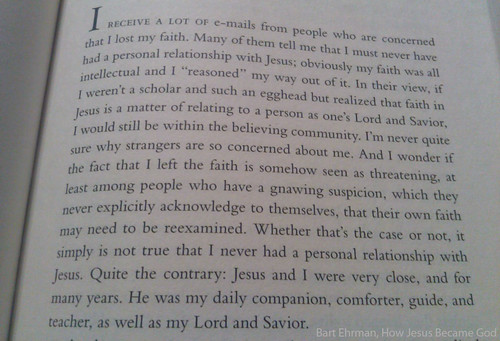
Bart Ehrman was once an evangelical himself. He attended Moody Bible Institute and all.

It was through his study of early church manuscripts and texts that he developed a more "liberal" view of the Bible, seeing it as a very "human" book instead of the inspired word of God. It wasn't this by itself that eventually led to his agnosticism, but it played a large part. Knowing this about his personal history gave these books more credibility to me. He is not a "militant atheist" out to destroy any chance that the Bible might be true. He's a man who once believed in Biblical inerrancy and divine inspiration and who himself once had a "personal relationship with Jesus". He didn't go into the field of textual criticism to debunk Christianity; he went into it to strengthen it.

Bart Ehrman has written several books, and I'd like to get my hands on all of them eventually. The haze of early church beliefs has finally started to lift for me, as I see the Christian religion for what it really was - a fascinating religion that expanded in nuance through time and gained popularity through Roman politics.

Tuesday, 29 April 2014

Responsibility of Empathy


Hey kids! Tell 'em what you really think, think it over. This is your life, don't ignore it. This could be your only chance to repent, so get off your knees and adore it, the responsibility of empathy. - Quiet Company

These tornadoes last Sunday in Arkansas (as well as the tornadoes that hit Oklahoma, Missouri and Mississippi) have really had an impact on me. Some things you just feel personally involved in. I was fortunate enough to be 20 miles away from them and don't personally know anyone who was directly impacted by it (though I have many friends of friends who were injured, lost homes and lost loved ones). Some things just call you into action; these tornadoes are one of those things.

One obvious reason this particular disaster is so important to me is that it literally hits home; the communities destroyed by the storm are communities I grew up around, had friends in. They are right down the road. It could've been us. It was so close. We were in the storm too, we felt the rising panic, we had our closet ready to take shelter in.

But there's something else to it.

I've realized that for the last several - well, all actually - years of my life, I've been very selfish and lazy. I don't mean these things didn't impact me then. They always have, especially those that personally hit home. Some things affected me more than others. That is natural, and I don't blame myself for not springing into action after every evening news bulletin. The problem is - and my regret - is that my go-to 'action' tended to be prayer.

If I couldn't do anything - and often I felt I couldn't - I just prayed. Sometimes I prayed fervently, sometimes I just prayed flippantly (though I didn't mean to be flippant). I prayed for victims of Hurricane Katrina and tsunamis and Sandy Hook Elementary School. These tragedies happened so far away from me that it's true I couldn't really do anything to help. So I just prayed.

What I regret now is that praying is all I did. I didn't try to think any harder for ways to help.

We can argue all day long whether prayer really works (I'd argue it does not). That's not actually the point (though, it is intimately entangled with the point, nevertheless). The point is, I felt praying did something and therefore I had done something and thus I could go back to my regularly scheduled program. Praying took away the guilt and helplessness and let me get on with my life. As my conscience would prickle and remind me of those still suffering, I'd offer up another prayer, as if it did something. It allowed me to move on.

Prayer, as it turns out, is a supremely selfish and lazy 'action'. It makes the one praying feel better and that is it. It does nothing for no one. (I may end up having to argue against prayer if I keep going this route!) It is not an 'action' at all, no matter how much emotion you put into it.

I first discovered this only a few months ago. A high school friend's dad died unexpectedly. She came back into town for the funeral. I hadn't seen her in years, so I didn't really know what to say or do. I realized that my normal response would have been prayer, but by this time, I had already become atheist. I had no idea what to do. I didn't want to believe that atheists really did have no hope to offer (a belief I'd always held before), so what then could an atheist do without those magic words 'I am praying for you'?

They get creative.

They get real.

They take action.

Like I said, I hadn't seen her in years, aside from the quick one-off reunion get-togethers, so it wasn't appropriate to just 'be there' for her. She doesn't have kids that I could've offered to watch for her while she processed her shock and grief. She had lots of family around her to support her. I knew the only thing to do was to put myself in her shoes (as uncomfortable as that was, facing the idea of a parent's mortality) and think of what she might need from a random old friend.

I thought about the mundane things that need to be done, despite a tragedy. Housework, bills, groceries. I thought about how no one really feels like eating at meal times but get hungry sporadically through the day. No one feels like cooking, so someone makes a fast food run. Fast food just makes them feel worse though, which is not what they need right now.

I'm not rich, let me just state that. We don't have a lot of money to spare. But I could spare a small bag of groceries. I ended up picking up some bread, cheese, ham, lettuce, bananas, milk and a box of cookies. I swung by her mom's house to drop them off.

It was seriously awkward.

Her sister who didn't have a clue who I was answered the door. She said her sister wasn't home. I awkwardly, self-consciously handed her the bag of groceries and said something stupid like, 'Just in case you all get hungry.' Then we both stood there uncomfortably for a couple of seconds before I said, 'Bye...' and turned back to my car and drove off. I felt like an idiot.

Getting creative during a tragedy isn't easy. It requires you to imagine yourself in an uncomfortable situation to realize what someone else might need. Getting real requires not always knowing what to say or how to say it and feeling awkward and fidgety and stupid about it. Taking action means sacrificing a little of your own comfort (that little bag of groceries had to come out of my already tight grocery budget for our family, meaning I didn't have as much to spend later that week on us). It's not easy. It's not nearly as easy as praying.

I guess I feel that I have a lot of inaction to make up for. A lot of 'just praying' and doing nothing. We have a responsibility on this earth to express and demonstrate empathy for one another, not just in thought but in deed. I have been inactive long enough. I have been selfish long enough.

I still don't have lots of money to donate to the tornado relief. We still don't have many items around the house to donate, seeing as we moved here less than a year ago with nothing to our name but twelve suitcases, having sold/given away everything we owned in the UK. I have two small children at home, so I can't do much in the way of volunteering. I found out today I can't even give blood because of my years abroad. But this won't stop me anymore. I won't use inconvenience as a reason to do nothing. I won't just sit around, tossing up a quick prayer now and again to ease my guilt and helplessness. I just have to get creative. I'll donate what little household items I can. I'll cut a few things out of our budget (that beautiful necklace I wanted to buy for my friend's birthday will just have to wait). I'll encourage others to donate needed items and give blood in my place. I'll babysit my neighbor's kids to free her up to go volunteer. If I can find a babysitter myself, I'll give some of my time too.

If you believe in prayer, go ahead and pray too. But please don't just leave it at that. We only have a few years on this earth to make a difference. Get off your knees and take on the responsibility of empathy. Adore it.

Monday, 28 April 2014

Don't Just Pray For Arkansas, ACT For Arkansas

Last night, a series of tornadoes passed through my state and devastated at least three cities. It was a terrifying night, watching massive black storm clouds blow over my house, seeing clouds swirling in what appeared to be the beginning of a tornado outside my back windows, and listening to the weather station directing people to take immediate cover. At this moment, there have been at least 16 fatalities, but this is not likely the final count. Emergency rescue teams worked through the night and are still working to recover families buried in the rubble.

This has really hit me hard. Being utterly helpless in a situation like this is difficult. Wanting to do something, wanting to make a difference to the survivors is (for many) a natural response, which is why I get why everyone on Facebook keeps posting this:


But it still upsets me. Yes, people want to feel like they are helping. Yes, there is little we civilians can actually do. Praying makes people feel like they are doing something.

But guess what. It's not.

Here's what we CAN do:

-Donate money (try here here or here)
-Donate supplies (bottled water, batteries, flashlights, first aid kits), food, clothing, baby necessities, blankets and shoes
-Volunteer to help WHEN volunteers get clearance to help, not before
-Set up drop off venues to collect donated items
-Open up your home to an acquaintance who has lost their own
-Spend time with survivors who have lost a loved one or babysit their kids while they process their shock

What we can do is little, but it's practical. Praying, well, if you believe in it, I guess it makes sense, but it's not the ONLY thing you can be doing. It's actually the lazy way out.

(I'll write more about that subject later.)

For now, I humbly ask, as someone who has very little herself and knows that it's not easy to donate the little you have, to DO SOMETHING instead of or alongside your prayers.


Sunday, 27 April 2014

Conceal, Don't Feel


Like all things that get super popular super fast, the Disney movie Frozen has started to receive its inevitable backlash. People are finding all the plot holes, like the dodgy parenting and crazy acts of a crazy sister. And of course, people are sick of the songs, like "Let It Go" in particular.

But you know what? I loved the movie. And I love "Let It Go". And here's why.

First, let me state that I think it's just an adorable movie. It's entertaining, the characters are charming, Idina Menzel rocks my world and has done since playing Maureen in RENT. It's a kids' movie, so I don't worry much about why on earth a couple of parents would think it was wise to lock a kid up rather than teaching her how to control her powers. I love the message at the end that a) you don't need a man to save you and b) the act of true love that saved her was committed by her own love for her sister. Come on, it's a great message.

I just love it.

"Let It Go" is a great song. It's got all the Disney/Broadway key elements to it - passion, emotion, a a riveting crescendo, Idina Menzel. It's not about lesbianism (though even if it was, I'm cool with that) but about freeing oneself from the conformity forced upon them. In Elsa's case, it was the freedom to freeze a bunch of stuff without (she thinks) any retribution. And I suppose for a girl who realizes she's a lesbian, it's a song about the freedom to come out. (Though Elsa was not a lesbian. This just isn't in the movie. For me though, it's a song about letting go of religion.

I know I'm not alone in this. I know there are lots of other people who have been reduced to tears by the power of Elsa's words in this song in the context of "letting go" of the religious beliefs that they have been conforming to for years. I'm just going to go through this song, emboldening the lyrics that really touch me, and if necessary (though I'm sure you're smart enough to get the connections) adding some commentary on how it makes me feel in that context. Keeping in mind the song IS about freezing stuff, so you know, the "snow" would have to become metaphorical, which is actually still a pretty good metaphor for someone feeling stuck in a belief system and culture they can no longer accept for themselves. It's a pretty frozen place to be.

The snow glows white on the mountain tonight
Not a footprint to be seen.
A kingdom of isolation,
And it looks like I’m the queen.

The wind is howling like this swirling storm inside,
Couldn’t keep it in, heaven knows I tried


[Heaven KNOWS I tried. I tried for YEARS to contain the storm that was swirling inside me. Knowing I didn't really believe any of this anymore but refusing to accept it. I tried so hard, but eventually, I just couldn't bear the storm inside me any longer.]

Don’t let them in, don’t let them see,
Be the good girl you always have to be.
Conceal, don’t feel, don’t let them know,


[I wanted to be that good girl I'd always been - the girl who lead worship at church, who knew the Bible intimately, who spoke up at Bible studies and prayed out loud, who loved people and reached out to them. I didn't want anyone to know I wasn't that girl anymore.]

Well, now they know!

[Actually not too many know yet. Word is getting around though.]

Let it go, let it go
Can’t hold it back anymore,

Let it go, let it go
Turn away and slam the door!

I don’t care
What they’re going to say
Let the storm rage on,
The cold never bothered me anyway.


[I'd like it not to bother me, that is. It actually does.]

It’s funny how some distance
Makes everything seem small
And the fears that once controlled me
Can’t get to me at all.


[It's true. The further I get from it, the less I worry about it. The less I'm afraid of "hell", the less I'm worried about how people will treat me, the more I realize just how ludicrous Christianity, and all religion, is. Particularly poignant is how the "fears that once controlled me can't get to me at all" is - the threat of hell is horrifying and paralyzing, but the further away I get from it, the more I see it for what it is: manipulation.]

It’s time to see what I can do,
To test the limits and break through.
No right, no wrong, no rules for me,
I’m free!


[Without religion telling me what's right and wrong, I can finally accept what my heart has been telling me for years about right and wrong. Technically, without religion there is no actual "right and wrong"; that doesn't mean however that non-religious people have no morals. We are just willing to use critical thinking and humanitarian principles to inform what is ethical and fair. Like letting gay people get married.]

Let it go, let it go,
I am one with the wind and sky


[Sounds silly, but now that I see myself as a evolutionary development, I do feel more connected to the earth. We sprang from the earth, and we will return to the earth. It's kind of an amazing thing.]

Let it go, let it go,
You’ll never see me cry.

[Not true. But wouldn't it be nice if it were?]

Here I stand
And here I'll stay.
Let the storm rage on...

My power flurries through the air into the ground,
My soul is spiraling in frozen fractals all around,
And one thought crystallizes like an icy blast
I’m never going back,
The past is in the past!


[Can I get a non-religious AMEN to that?! It's the most freeing thought that I'm NEVER going back - the past is in the past!! Here's hoping I have at least another thirty years on earth to make up for the thirty years I lived in ignorance!]

Let it go, let it go,
And I'll rise like the break of dawn.
Let it go, let it go,
That perfect girl is gone.


[I don't have to be perfect! I can make mistakes! I will do my best as always to keep being the best me I can be, but now, I don't have a cosmic finger wagging at me every time I screw up or a book of rules to point out how supposedly broken I am inside. That perfect girl is gone; she left nothing but normal old me behind. Yes!]

Here I stand
In the light of day.

Let the storm rage on!
The cold never bothered me anyway.


[One day, one day soon, I'll stand in the light of day as an agnostic atheist. I'm still working on finding that courage within me.]


For so many years, I had the same Elsian (new word?) philosophy: Conceal, Don't Feel. "Put on a show; make one wrong move and everyone will know."  I concealed, not so much to myself or even to "God", but to everyone else, my doubts. I refused to feel how my doubts made me feel. Any time I allowed my feelings to spill over, I was drowned in my own tears, and drained afterwards from the emotional and mental distress. Losing my faith was utterly the most painful experience of my life. Having to conceal it so no one would know was exhausting. Keeping it to myself, refusing to feel it, refusing to "let it go" was isolating, like being locked in a dungeon all alone. The fear of what would happen if I "let it go" (aka hell) was more than I could bear.

Like Elsa, once I let go, everything changed. Even though she went through a rocky period before knowing how to "let it go" under control, she experienced freedom for the first time when she just let all that power explode around her. I know how Elsa felt, letting the storm rage on. It felt glorious.

Sunday, 13 April 2014

The Capital G

Another thing that's been annoying me... The letter G.

I've been coming up against this problem constantly in my book that I'm writing. You see, I'm a bit (a lot) of a grammar nerd. (Don't judge me now if you find a mistake or two - trust me, if I see a mistake, even if it's years old, I will EDIT that shit.) I appreciate the proper usage of grammar but can totally appreciate improper grammar if there is proper intent for the misuse.

So, God. Or god?

I have always referred to the Christian God in print and in thought with a capital G. It is not just correct usage to capitalize the first letter of a proper noun, it is also acceptable when emphasizing the singularity or ultimateness (totally not a word) of the noun in question. In the instance of the Biblical God, from a literary standpoint, the capitalization works both ways. The book maintains that this is not only his name, but that he is the ultimate, supreme "God".

Furthermore, the capital letter signifies reverence. Christians capitalize God to illustrate his Holiness and Sovereignty above all things.

It always annoyed me when people, believers or non-believers, referred to God as god, not just because it was irreverent but because it seemed grammatically incorrect. It was a proper name, and it reflected his One True Godness. Thus the capital letter. Like calling my mom Mom, my One True Mom. (Those were intentional sentence fragments, by the way. Fragments are unacceptable in formal writing but acceptable when intentionally spoken colloquially. I mention this, because the moment one claims to be a grammar nerd, all the other grammar nerds rush in to prove that they are nerdier. I am pointing out my intentional errors to justify them before the Holy Judgment Seat of Fellow Grammar Nerds. You must know the rule in order to break the rule is my favorite rule.) I also refer to Allah with a capital A and Zeus with a capital Z (to get back to the subject).

I no longer attribute ultimateness (there really should be an actual word for this) to the Christian God, so no longer do I feel the need to unnecessarily capitalize pronouns like "He" when referring to "Him", which was always pretty questionable from a grammatical standpoint anyway. But what about the name "God" itself? Should it still be capitalized?

I'm thinking of it like this:

1. It is extremely unlikely that there is actually any kind of "God" with a capital G - that is to say, an over-ruling singular God above gods, a one Power that oversees all power in the unknown expanses of this universe and all other universes and all other unknown others. So to attribute to the word "god" a capital letter is incorrect, because such a being doesn't exist. It is incorrect unless I'm referring specifically to the possibility of such a God existing, in which a capital letter might actually be literarily valid. It would be similar to my capitalizing Power in that first sentence; it would be an emphasis on its supremacy. Like absolute Truth or the concept of True Love or some other Dickinsonian capitalized attribute.

2. When referring to the Christian God, it is understood that the capital letter refers to God being God's name, "God" here being an actual being or literary character, like Zeus or Athena. It would be grammatically incorrect to write Zeus as "zeus" or to refer to me as "lori". Even my spell checker is giving me angry red squiggle lines for not capitalizing those two proper nouns. So in reference to this Biblical character, a capital G is legitimate.

3. Yet the very act of a writer taking a common noun like "god" and attributing to it a capital letter implies that the writer gives credence to that noun's supremacy, that this particular god deserves the name God, as if one church deserved to be recognized as the Church or one broccoli on my plate deserved to reign as the one supreme Broccoli. It seems to accept that belief that one specific god deserves the title God. That annoys me.

4. But to refer to the Christian God with a lowercase g annoys me in a grammatical and literary sense. Using Allah as an example, "Allah" simply means "God" in Arabic, but to call him allah seems to be the same as saying zeus or lori. It's still a name, even if it's a presumptuous one. Therefore when referring to the Muslim Allah as with the Christian God, surely the correct rule would be to use a capital letter. It goes back to being a proper noun, even if it is usurping a common noun in doing so. Yes, it's annoying that it allows the connotations of Holiness and Sovereignty to creep into the meaning, but the alternative would be fairly inaccurate grammatically. GAH!!!

If you've borne with me thus far, you'll (maybe) understand my (completely unimportant) conundrum. To capitalize or not? I think in practicality it turns out looking something like this:

The god of the Bible liked to destroy stuff.

Then God said, "Let there be light", which is how we got light.

I used to be mad at God when I thought he had abandoned me, but then I realized there was never any god in the first place. God never abandoned me, because that god never existed.

Totally cleared up now, yeah...?