Showing posts with label religion. Show all posts

Friday, 31 July 2015

Click Save, Don't Print

Last Thursday I was going through all our old backed-up files from Scotland on mine and Scott's shared drive, looking for "Throwback Thursday" photos to post on Facebook. I found some really old and fun pictures!

I also found a lot of old graphic design projects and documents. (Some of my designs I still think were good; some I was like "WHAT?!")

Then I ran across a letter I thought I'd long since deleted. But nope. It was still there. For some reason I kept it. I don't know why, because I was embarrassed about it right after I penned it.

It was a very old letter addressed to a friend. I am so humiliated by it that I will never ever admit anything about who it was addressed to. It was a friend. A long time ago. That's all I'm saying.

(Don't ask me if it was you. I won't admit a thing.)

I had written this letter out of conviction. A friend at church (someone I still love and adore and respect) had recommended writing this kind of letter to our non-Christian friends. I felt convicted after that to do so. I typed the letter up. I saved it. But I never had the guts to print it. I wanted to have the guts; I distinctly remembering praying for the courage to mail it. But I just couldn't. Maybe that's why it was still in My Docs. Maybe I had left it there until God had given me the courage to mail it. But I never did. And very soon after writing it, I was beyond embarrassed for ever even considering mailing it. I was SO FREAKING THANKFUL that I hadn't.

I had not forgotten this letter, by the way. I just thought it had been deleted. But no, it was anything but forgotten. I have thought about this letter a lot, so many times since writing it. I have thanked my embarrassment a gazillion times for keeping me from mailing it. It is terrible.

When I saw it in my old documents folder, a little bit of repulsion rose into my throat. No way I'm reading that again. I CANNOT face reading what I wrote.

But tonight, curiosity, and a little hubris (I finished my book! Feeling pretty chuffed!) enticed me to open up the letter and read it.

UGH. OH MY UGH.

I cannot share all of it. (Identifying details. I'm not telling you or anyone ever who it was addressed to so don't ask. It might have been you, but it probably wasn't.)

I will share some of it though. This, folks, is who I used to be. After finishing the book about my life as a Christian, I wondered if I had made myself sound too religious, more religious than I actually had been. Did I come across as a totally self-righteous prig?

Well if I did, it's because I WAS a totally self-righteous prig.

Here's the proof:

This is kind of a strange thing to do, but it’s been on my mind for ages now, so I guess I’ll just get on with it. For a while, I’ve felt like I should share with you how important my faith is to me. I suppose because you are my friend, and you’ve become one of my good friends, and it feels weird to me that I’ve never really talked about it much...

To sum it up, being a Christian is the biggest thing in my life. It is what makes me what I am. It enters into all parts of my life. I am easily able to talk about Jesus and prayer and what God has been doing in my life with friends from church, but it’s not as easy to do with friends outside church. Yet, because it really is so important to me, I want to be able to talk about it with anyone I’m close to.

Being a Christian for me isn’t just about going to church on Sundays and praying. It isn’t just something I do; it’s something I am. My beliefs enter into everything I do and think. The way I raise my children comes from my faith. The way I talk (though not always perfect) comes from my faith. The way I try to live my life, everything, comes from my faith. Often in conversations with my friends, I feel I can’t say certain things because it’ll sound odd because it sounds ‘religious’. But really, that is who I am. I don’t know why I can be so ashamed of it sometimes.

I also feel like it’s something I ought to share with my friends in another way, because I believe it is so important. I believe that only a life-changing experience with Jesus Christ can save us. I believe in heaven and hell, and I want the people I care about to know Jesus the way I do. This is the hard part, because I don’t like the idea of shoving my beliefs down anyone’s throat. I don’t like telling people what they should or shouldn’t think or believe. But I also feel that if I don’t at least tell them this is what I believe to the be the truth, then how can I really say I believe it that much? If I knew a certain drug or something was dangerous and could kill a person, or if there was a miracle drug that could save a person, wouldn’t I tell you? It’s the same with being a Christian. I believe that we must be saved by the grace of God to have eternal life (and not by any good we do ourselves), to spend it in heaven, so it only follows that I ought to tell my friends that too. Because I genuinely do believe it with all my heart. Would I be able to forgive myself if one of my friends died without me ever at least stating that? After that, it’s up to my friends to want to know more or not, but I should at least say it. So that’s what I’m doing here.

So really, this letter, hard as it is to write, has two purposes. One is to kind of ‘get it out in the open’ how real and important my faith is to me, so I don’t have to feel awkward when I want to say something, however casual , about it, and two is to just let you know that I really believe it’s important for everyone else too. Because you’ve been a good friend for a while now, it’s just been on my mind and my heart a lot to share it.

One reason I’ve put this off for so long is I’ve worried it’ll make our friendship awkward. I hope it doesn’t do that. I hope instead it makes our friendship more real, more honest. Don’t think I’m going to start shoving religion down your throat – that’s the last thing that will happen. I really don’t think that’s the right thing to do ever. I just hope our friendship can be more like the ones I have with people in my church, where I’m able to just say anything I’m thinking without worrying I sound like a weird religious freak... I’d only ever really get into deeper things if the conversation naturally went there. I hope that makes sense.

Okay. So now that I’ve written this, I’m going to go back through it, edit it and then decide what to do with it! My friend recently did this same thing; she had a friend she’d felt drawn to share the same things with, put it off for years actually (for the same reason – worrying it would ruin the friendship), but now that she’s done it, she says their friendship is better than ever – much more real and open and deep. I hope that’s the outcome with us.


I can sympathize with myself for writing this. I meant it so sincerely and so humbly.

But I know for certain it would have been SO SO WRONG to send it.

On the other side of the faith spectrum now, I can assure you this kind of letter would completely undermine a friendship. As sincerely and humbly as it was intended to be, it would have been a giant "DANGER" sign to the reader. With a smaller "THIS PERSON THINKS YOU ARE GOING TO HELL AND HAS ULTERIOR MOTIVES FOR THE FRIENDSHIP" disclaimer underneath.

Please, friends, don't ever do this. Christians, pray for your friends to be saved, as often as you like. But please never send them this letter.

Monday, 2 March 2015

Is Christianity a Cult?

Mormons, JWs and Christians

Christians love referring to Mormons, Jehovah's Witnesses, and several other break-away sects as "cults". Labeling them as such separates them from mainstream Christianity and orthodoxy (lest anyone confuse them with one another) and signifies to all would-be seekers that these are NOT acceptable organizations to involve oneself with. Needless to say, members of these religious groups do not appreciate being referred to as cults.

Whether or not they fit the above criteria isn't actually what I'm interested in. If pressed, I'd say they do. I'd also say so does Christianity. To the same extent Christians call Mormonism a cult, I could call Christianity a cult. Before going around labeling extremely large, well-organized religious groups "cults", Christians might want to pull the plank out of their own eyes first.

I'll use Mormonism, or the Church of Jesus Christ of Latter Day Saints, as my parallel example, since I know a lot more about them than I do JWs. As a damn good Christian once, I spent a lot of time researching the LDS so I could argue intelligently with them anytime they knocked on my door. I never once had a Jehovah's Witness at my doorstep, or I'd probably have researched them too.

Alongside Mormonism, I'm going to use two examples from my own Christian church experiences to compare and contrast with. I could upset a lot of people with my examples though, so out of sensitivity for people I know and love, I'll use the generic denominational descriptions - the New Apostolic Movement and the Closed Brethren. Then to be even fairer to "normal" Western Christianity, I'll pull examples from my childhood churches, which were technically non-denominational but conservative and very mainstream.

My intention here is really not to say all religion is bad (though sometimes I feel that way). It's to examine, from the outside, how there is cultish facets to all religion. While thankfully, one's life is not normally in danger after leaving the Judeo-Christian religion, and in general, physical and sexual abuse are not the "norm" in mainstream religion (as they can be in some of the smaller, more sinister cults one often thinks of when they hear the word), one still finds after leaving religion that indeed they had been brainwashed, had been controlled, and had been oppressed. I will try to show this by going through Robert J. Lifton, MD's 8 Criteria for Thought Reform. I will never be able to go into all the depth I could for each bullet point without writing a novel, so I will briefly give examples for each. If it appears I have been too generic or hand-wavey, it's for the sake of brevity. If it seems my Christian examples are weak, compare them to my Mormon examples, to determine if they are "weak" too. Perhaps a novel one day isn't a crazy notion, but for now, I'll just give enough basic examples to illustrate why I feel that in many ways, I too have escaped a cult.

I will use the following initials for each: LDS (Mormon), NAM (New Apostolic Movement), CB (Closed Brethren) and MC (mainstream Christianity.)

1. Milieu Control.This involves the control of information and communication both within the environment and, ultimately, within the individual, resulting in a significant degree of isolation from society at large.

This can be said to some degree of all my four examples, though on this point alone none would be considered cultish. On the most basic level, they are all expected to learn from their own scriptures, which is declared God's Word. Other non-sacred writings from within the group are encouraged, while outside material is viewed with suspicion.

MC, along with all the following, advocates "being in the world but not of the world", not being "unequally yoked with unbelievers" and "not forsaking the gathering together of believers", creating a sense of isolation (more on this in Point 5).

As far as I know, the same goes for LDS. They are not encouraged to shun non-believers, as far as I understand. But again, see Point 5 later.

The same goes for NAM. Though they were a little more leary of getting too involved in this world. While getting out into the world to share the Gospel was a must, there was also to be a strong separation intimately. Both MC, NAM and CB are against "being unequally yoked with unbelievers", whether in romantic relationships, close friendships or even business.

Not too long ago, CB were discouraged from going to movies or watching TV. Today, the CB believe that the Leading Brethren are infallible on matters of faith, and therefore their publications are to be read as absolute truth (the name of their newsletter is "Needed Truth" incidentally). They were very much supposed to stick together and shun the outside. Nowadays they don't do that so much, but they still refuse to work with other churches in community projects or allow their leaders to preach at other churches. Members are not to take communion at any other church but theirs. Really, they aren't technically supposed to even attend a different church.

Is this different from being completely isolated from the world, from outside communication, and unbelieving family members like the cults we imagine? Yes. Is it still a degree of isolation from outside influences? Yes.

2. Mystical Manipulation.There is manipulation of experiences that appear spontaneous but in fact were planned and orchestrated by the group or its leaders in order to demonstrate divine authority or spiritual advancement or some special gift or talent that will then allow the leader to reinterpret events, scripture and experiences as he or she wishes.

This is less true for all four examples, at least overtly. Is there proof of this in most churches, LDS or otherwise? Christians love to point out the Temple rituals of the LDS as mystical manipulation, and having never experienced the Temple Endowment, I can't speak authoritatively on it. From the outside, yes, a lot of it looks manipulative and staged. Hours of trance-like prayers, bizarre group reenactments, practicing secret handshakes and passwords to bypass the angel guards in the Celestial Kingdom, ceremonial washings and anointings. The environment is very psychological. (However, keep in mind that not every Mormon is a Temple Mormon.)

What, then, of MC? In most churches, including NAM churches, the lights are turned down low, the music swells, the songs repeat the same line over and over again until the congregation is in a trance-like spiritual state, emotions are played upon, requiring attendees to search their souls and root out all sin, bringing many to tears. There is emotional and psychological manipulation going on in most MC churches. (Not to mention some of their outreach programs.) Depictions of the cross with an emaciated Jesus hanging, oral descriptions of the pain he suffered for us, admonishments for the sins in our own hearts that nailed him to the cross. Sermons that remind congregants of their inherent wickedness as the piano starts to softly play and the altar call is made.

In the NAM and other charismatic churches, people begin speaking in strange tongues, shake, fall out, wail, prophesy, and dance. In some, demons appear to be cast out of people. People claim to have visions from heaven. (I've even heard personal testimonies of having been teleported or of having a glowing aura while prophesying.) Is this mystical manipulation too? Once the congregation is in this repentant, submissive, broken state, the preacher then tells them what to do - be saved, be baptized, give money, join the church, repent, come forward.

The CB to its credit is not into mystical anything. There are never any charismatic acts of healing, tongues or prophecy. They do not use instruments in official church meetings. They do not set any moods. The only manipulation of this sense was intellectual. You believe what they said because the leaders are infallible on matters of faith. They don't use tricks to make you believe that. They just tell you what to think. (And don't like it much when you disagreed.) Still, there's not really any "mystical manipulation" in the CB.

Is this different from cults staging wild spiritual phenomena, like visions, exorcisms, and demon-casting, like we imagine? Only a little. Does the lesser degree of staging spiritually enhancing environments make it less intentional and manipulative? No. Do wild stagings happen in mainstream churches? Yes. See TV preachers such as Benny Hinn for obvious examples, but they happen in the NAM all the time too, whether they are patently false and acted out, or simply psychological delusions.

3. Demand for Purity.The world is viewed as black and white and the members are constantly exhorted to conform to the ideology of the group and strive for perfection. The induction of guilt and/or shame is a powerful control device used here.

I really shouldn't have to convince anyone of this. This is very obvious. MC view the world as black and white, saved and unsaved, and those who are Christian are the right ones while everyone else are the wrong ones. Christianity is considered (by themselves) as the One True Religion. Jesus is the only way to heaven. We as human beings are to strive to become holy and blameless, just like Christ. Most Christians will admit that this is impossible this side of heaven, but we are to strive for it regardless. Guilt and shame (disguised as "conviction" and "admonishment") are major forces. While they would claim that in Christ we are free from all condemnation, guilt and shaming devices are used every Sunday to remind us of our shortcomings in relation to God and to repent and strive harder.

In the CB, certain sins are treated as extremely guilt-inducing and will get you kicked out of the church, such as sexual immorality and divorce. While you can be re-admitted into the church, it is after a time and alongside public confession (see the next section).

In the NAM, sin is still just as terrible, but there is a lot more leniency and "grace" towards sinners. However, this is no license for slacking. Purity is the goal. Those within the movement, whose hearts are right with God and totally for God, forsaking all else, are the truly saved ones. The rest of the world are just nominal Christians. If those lackadaisical people are even truly saved, they are only barely saved. You are either one hundred and ten percent living for God, or you are not living pure enough. This can be said of many churches and many denominations within MC too. There is a strong us vs them mentality all throughout MC.

As for the LDS, this is taken to a different level. While Christianity claims that none are perfect and we can do no good of our own, and salvation is completely a gift of God and not anything to do with our own works (though good works should follow salvation), the LDS believe "it is by grace we are saved, after all we can do." Purity is very important to Mormons too, but perhaps even more so, since salvation somewhat depends on it. The consequences are more nuanced though. less black and white. Rather than the choice of Heaven or Hell, there are levels of heavenly homes, the Celestial Kingdom reserved for good Mormons, and lesser heavens for the good people, Mormon or other. Only the really nasty level (which still isn't "hell" per se) is reserved for the really nasty people. As for guilt and shame, most ex-Mormons I know will admit that these are very powerful tools within the community to coerce obedience. Most ex-Christians I know (including myself) will admit that guilt and shame are powerful tools the Christian community also use to coerce obedience. Not necessarily explicitly, but most certainly implicitly.

Is this different from the purity demanded of cult members and the guilt and shame used to keep them in line? I don't think so at all.

4. Confession.Sins, as defined by the group, are to be confessed either to a personal monitor or publicly to the group. There is no confidentiality; members' "sins", "attitudes" and "faults" are discussed and exploited by the leaders.

I'll start here with the CB. As I mentioned a moment ago, certain sins will get you excommunicated. These sins are read out in a letter to the entire membership of one's particular assembly. If the excommunicated public repents of his sin and stops the act, they can be re-admitted into the assembly. The best examples are sexual immorality and divorce. If one has pre-marital or extra-marital sex, it is to be confessed to the church leadership and excommunication will follow, regardless of the repentant nature. If the sexual misconduct has ended, one can be later re-instated. As for divorce, the initiating spouse will be excommunicated. Neither spouse is allowed to remarry. If the spouse does remarry, he or she will be excommunicated, though if he or she later "repents" of the second marriage (though the second marriage does not need to be dissolved), the remarried spouse may be re-admitted to the assembly. In CB churches, these sins are definitely discussed publicly and in many ways exploited by the leaders.

In the NAM, while there are no concrete rules like this, public confession is strongly encouraged for accountability and purity. In my own experience, I was encouraged to confess any sins or bad attitudes I'd committed during my weekly home group meetings and with my mentor. I was encouraged to confess my sins to anyone who was considered in any kind of authority to me, all for the purpose of purifying my heart and in some cases, casting out the spirits of this or that. I wouldn't say these things were ever exploited by the leaders in my own church, but they have been in other NAM (and MC) churches. "Confessing your faults one to another and praying for one another that you may be healed" is a Christian concept. In Roman Catholicism, Confession to a priest is a well known sacrament, as well as a command. In all churches I've attended confession is encouraged to greater or lesser degrees.

The LDS are to confess sins to their Bishop, as taught in the Doctrines & Covenants. He then determines the consequences, as far as revoked sacrament-taking and other church-participation privileges, all for the sake of bringing one back into good standing with the ward and God. A guilty conscience will determine if confession is necessary. As with Christians, the purpose is to absolve one of personal guilt by confessing to someone else, often a superior.

Is this the different from confessing sins publicly in front of the entire group and having it used against you? Maybe, but maybe not. Depending on the group we are talking about, faults can be either very publicly used against you or only privately exploited. Punishments and consequences of your faults, sins or attitudes are determined by third party.

5. Sacred Science.The group's doctrine or ideology is considered to be the ultimate Truth, beyond all questioning or dispute. Truth is not to be found outside the group. The leader, as the spokesperson for God or for all humanity, is likewise above criticism.

There is a lot of overlap here with Point 1. Within MC, members can sometimes be "encouraged" to study outside their religion to bolster their faith (and churches who encourage this ought to be given credit for their confidence and bravery), but at the same time, they are warned that the Devil is tricksy and can lead them astray if they study these things without being properly spiritually prepared. Which is the same as saying, "Unless you are super Christian, best not get into that just yet." They also, of course, believe the Bible to be the absolute truth (though there are progressive churches that accept the Bible as metaphorical) and all information outside the Bible, including science, is to be regarded with caution at best. At worst, they are tools of Satan to confuse you and lead you astray.

Reading anti-Mormon (LDS) literature is actively and pretty explicitly discouraged. You won't get in trouble for reading it or anything, but you'll be counselled not to. The above MC stance again applies to LDS.

The NAM, as far I know, don't push any particular written materials but to a lesser extent accept as reliable evidence the testimonies of other members, regardless of how fantastic their stories or preachings are, because they are perceived as from God. The Bible is not so much a closed canon for them; God can reveal new information to anyone at anytime. They took it a step further sometimes, though, that outside information and influence might actually sometimes be a way of allowing demonic spirits into you or into your home. So basically, be on alert at all time (but accept our testimonies as true because they happened to us so it's definitely true).

For the CB, since the leaders are considered infallible in matters of faith, their publications are to be taken freely as absolute truth. They follow the Bible as the sole source of truth, and their leaders' interpretations of it are considered correct. Other interpretations, even those of other Christian churches, are wrong or misguided. Again, members and leaders are to remain separate from even other Christian churches. If the Body of Christ includes all Christians, they at least consider themselves the Head. (Yes, this is an example they have used.)


6. Loading the Language.The group interprets or uses words and phrases in new ways so that often the outside world does not understand. This jargon consists of thought-terminating cliches, which serve to alter members' thought processes to conform to the group's way of thinking.

I'll admit this is a hard one, though I feel it should be obvious. I guess I just don't think of it as "cultish" really. I mean, all groups have their jargon; hang out on Reddit or in a sailing club and you'll be utterly confused about what anyone is talking about. I guess the point is that this can separate people further from outsiders, that they can load meaning into words that the Average Joe would use more simply. Words like "righteousness" and "holiness" are perhaps harder to come by than you might think. I don't know. We all know that all Christian groups have their "language". Maybe this is the one where we all get let off the hook. Maybe stereotypical cults do this to an extent I don't understand?

7. Doctrine over person.Members' personal experiences are subordinated to the sacred science and any contrary experiences must be denied or reinterpreted to fit the ideology of the group.

This one is different for all the groups.

So within MC, usually doctrine always takes precedent over personal experiences. In general this is means in a situation where a member says they have felt God telling them that X is okay but X is condemned in the Bible, then the Bible is right. Or if someone has had some kind of religious experience that is contrary to Christianity, their experience was a delusion. Or if someone (like me) does NOT feel any experience that the Bible claims I should, then the Bible is still right and the problem is within the person's own heart. Basically cognitive dissonance always wins. In evangelical churches were charismatic behavior is not the norm, any supernatural experience such as speaking in tongues is also considered faulty and the person's sincerity does not trump what the Bible says (according to them). I think it was Martin Luther who said, “I wouldn’t believe you if you had swallowed the Holy Ghost, feathers and all!” Scripture and doctrine trump what you've experienced.

I'm not sure how the LDS approach this. I do know that individuals' experiences are confirmed by "the burning in the bosom" which comes when truth is revealed. (Before MC scoff, this is no different than the feeling you get when God "speaks" to you.) I am going to assume, however, that if the burning in the bosom occurs over something contrary to their belief system, this will be considered deception.

The CB are very strict about this. No one's personal experience is more believable than the Bible or church doctrine. End of story.

The NAM, however, are very, very different on this one. Personal experiences actually CAN overrule doctrine at times. As long as it confirms God and Christ. If it deviates from the accepted truth too far, then it will likely be ruled out. But a person can claim all kinds of fantastic things, as long as it continues to uphold a general belief in Christ.

In all situations, when personal experiences fail to prove God, the situation is reinterpreted to fit their ideology. A person who prays to God for faith and gets nothing did not get denied faith by God but is still too sinful or too proud or too something (anything), which is getting in the way of actually knowing God.

So, Points 6 and 7 - pretty weak evidence that Christianity is a cult, right? Would you admit the evidence is weak for Mormonism too then on these two points?

8. Dispensing of existence. The group has the prerogative to decide who has the right to exist and who does not. This is usually not literal but means that those in the outside world are not saved, unenlightened, unconscious and they must be converted to the group's ideology. If they do not join the group or are critical of the group, then they must be rejected by the members. Thus, the outside world loses all credibility. In conjunction, should any member leave the group, he or she must be rejected also.

Absolutely. Absolutely true of each of these religious groups. Obviously MC believe they are saved, they have received the truth, they have been chosen in some cases, and the rest of the world are in darkness, have rejected the truth, are lost, unsaved and must be converted to avoid eternal punishment. They also conclude that those who have it close to right, but not right enough (like say, Mormons, JWs, etc) are also lost, unenlightened, deceived. And going to hell.

The LDS believe this too, minus the eternal punishment (unless you're a REALLY nasty person). Mormons believe that MC have it close to right, but not right enough, therefore they are unenlightened and need to be converted to the absolute complete truth.

The NAM believe they are the ones who have it really right and all the other Christians are not quite Christian enough. They won't be lost, but they aren't as enlightened as they are, or as serious about their faith, or are missing out on some really great things God is doing. Those outside Christianity (including Mormons, JWs, etc) are lost and in darkness and deceived. And going to hell.

The CB believe they have it totally right and all other Christians are not totally right enough. They won't be lost, but they don't have it all exactly right. And anyone outside the Christian faith (including Mormons, JWs, etc) are deceived and lost and not saved. And are going to hell.

And for all these groups, the more adamantly against their religion you are, the deeper into darkness you are. If you are actively anti-Christian or anti-Mormon, you are even more deceived and pitiable. Christians (mainstream, ultra-conservative or not) really don't like atheists and Muslims who they perceive as actively anti-Christian (sometimes this is true, sometimes not) and consider them to be the most lost. Depending on your particular congregation, these people are to be either totally rejected or even more reached out to to get them saved. However, should someone actually LEAVE any of these groups, shit gets REAL. There are exceptions, sure, but in general, MC, LDS, NAM and CB all to some extent turn their backs on those who first turned their backs on them. They can lose family members, friends, jobs, everything. Having personally experienced this after leaving the CB and Christianity as a whole, I can attest to the fact that you will be rejected (though individuals may still keep some slight form of contact). Having friends who have left the LDS, I know this also happens there too, often.

Signs you left a cult? When everyone turns against you and rejects you (in our case, we were labeled as tools of Satan, in almost as many words), or when you friends and family turn away from you because you left their religion or church, does that sound like leaving a cult? Does the Sailing Club turn away from you in anger when you lose interest in sailing? Does anyone even notice when you stop posting on Reddit?

If you think none of this is solid evidence that Christianity is a cult, then that's fine. Just ask yourself then, is Mormonism anymore or less of a cult than Christianity? Is the Closed Brethern or the New Apostolic Movement? Are Seventh Day Adventists or Jehovah's Witnesses any more or less cultish than Christianity?

But of course Christianity isn't a cult because it's the truth and all the rest of these are false!

Right?

Wednesday, 23 July 2014

I Don't Need To Join Another Cult!


So lately I've been really into documentaries. I've been watching documentaries on Netflix on anything and everything, from Mitt Romney to asexuals to sushi.  I've watched several documentaries on various cults, which I find extremely fascinating.

On a seemingly entirely different subject, I've recently really gotten into fitness and working out and (mostly) healthy eating.  I've started a Love My Body project and have been focusing not so much on losing weight, but on feeling good about myself and embracing - and loving - the body I have.  I can do a little to shape and sculpt it, but at the end of the day, the frame is the same and I am learning to love my curves.

One night, at a Zumba Toning class, a guy introduced himself to me and invited me to come along to a local fitness group.  The Zumba Toning class already appeared to be made up of 30 or so people who clearly knew each other's fitness goals intimately, and they all rallied around encouraging me to join their group.  I smiled and thanked them for the invite, and just barely stopped myself from quipping, "Thanks, but the last think I need is to join another cult!"  I realized just in time that such a joke may not come across as funny as I thought it was.

Not only did I realize that calling their fit group a cult would be insulting, but it would also insinuate that I'd been involved in cults previously.  And when one thinks "cult" they think documentary-worthy cults, like the Fundamentalist Latter Day Saints or the Martha Marcy May Marlene variety.  No, I was never in one of those.  I never lived in a commune or was physically abused.  All the religious organizations I've ever been involved with were more or less legitimate, mainstream churches.  Some more mainstream, some definitely less.


Yet both of the two main churches I attended for a lengthy amount of time as an adult have been only two or three steps away from cultish.  One church was loosely affiliated with a group that, if not actually considered a cult itself (though I'd consider it one), had some very cult-like offshoots; the other was literally a breakaway from a cult (even if the breakaway was decades ago).

It wasn't until I left that second church that I realized how cultish it had been.  I'd been reading about the organization my church had separated itself from, and I was horrified by how similar they still were.  While they'd relaxed rules about strictly not associating with outsiders or banning TV, and while thankfully the sexual misconduct that emerged from the original church was, as far as I know, absent in our current church, most of the rules were still pretty much the same, or at least had only changed in the last fifteen to twenty-five years (such as being allowed to marry "outside" the church).  A couple of steps away from cult.  And the freedom I felt when I left it! And the horror when I realized how long I'd just accepted it...

I must admit I now shy away from anything resembling a too closely-held belief system, whether it be political, social or especially religious.  I was sucked into it for too long, even as an intelligent, thinking, supposedly not easily suggestible person.  I'm afraid of getting sucked in again.  Another cult is the last thing I need!


Saturday, 21 June 2014

Hear Ye, Hear Ye!

When one becomes a Christian, it's part and parcel to share that news with the world. We are told we should not hide our light under a bushel but shine it on a hill. 'If you deny Me on earth, I will deny you before My Father in heaven.' (Matthew 10:33) Sharing our newfound faith is an important part of becoming a Christian. Baptism follows, which (varying degrees of significance amongst denominations aside) is a commanded public pronouncement of faith. If one were to become a Christian and keep it to oneself, there would be much speculation on the sincerity of that transformation.

However, when one leaves the Christian faith, it is something to be hidden. It is scandalous. It is in some cases jeopardous, even dangerous. In a Christian society, leaving the faith is most definitely NOT something to shout from the rooftops. While Christians would praise a Muslim for bravely coming out as Christian to his or her family (thereby likely being disowned, if not downright in danger of death), they cannot conceive of a Christian coming out as Muslim, or Jewish, or even Mormon, or -gasp- atheist, and why that person would want to share that terrible news with the world.

So I hide.

More than anything I want to announce to the world that I am atheist. I want to finally get it out in the open, so I don't have to hide who I really am anymore. I don't have any ulterior motive; I'm not out to change you or persecute you. I just want to be free. I want to be known.

But I'm afraid.

I'm afraid of losing friends.

I'm afraid of losing family.

I'm afraid of losing my job.

I'm afraid of losing clients.

I'm afraid of hurting my family.

I'm afraid of humiliating my family.

I'm afraid of putting my children at risk of bullying.

I'm afraid of putting my children at risk of proselytizing.

So I hide.

It is shameful that in a country that was literally founded on people seeking religious freedom, people are not allowed to be free from religion. Religious freedom was not set aside for Christians exclusively. It was intended for all religious people - and non-religious too - whether their beliefs were Muslim, Hindu, Jewish, Buddhist or Baptist. Or atheist.

But the reality of it is, if you are not Christian - at least here in the Bible Belt - you are at risk. If you leave Christianity, you are an apostate - which is sometimes worse than being Muslim or Hindu (and therefore 'simply a part of your culture'). You may be seen as actually disgracing your family and bringing shame upon their religion... not unlike the Muslim who leaves Islam.

When I first spoke out against my church (still then a Christian), I was reproached for 'giving Christianity a bad name'. Many people felt what I had done was only further non-Christians dislike for Christianity. While I saw their point, I also saw the other side of it. Hiding the faults of churches furthers the non-Christian dislike for Christianity too, perhaps more so.

Apostatizing is perhaps the worst thing a Christian can do. It gives the religion a bad name. It gives non-Christians more ammunition. It lends credence to the possibility that Christianity is not the only answer.

Worse than anything, it waters the seeds of their own doubt that Christians don't want watered.


When I became a Christian (or rather, 'rededicated my life'), I told everyone. I didn't want to hide it from anyone. Even in situations that felt awkward, where I felt I might lose a friend or make myself look stupid, I made my faith known. I did not want to deny Jesus here on earth. When asked, 'So, do you think I'm going to hell?', I awkwardly answered yes. It was of utmost importance that I made sure everyone knew I was a Christian. I may have lost a couple of friends, though if I did, I never knew about it, but there was never any real backlash. I was accepted into a church and a society that congratulates such a decision, and everything was hunky dory. Some people thought I was a little nuts, but it didn't get much worse than that.

Unfortunately, I know for a fact that if now I shared even a fraction of that kind of openness about my non-faith, there WOULD be backlash. I KNOW I would hurt and humiliate my family. I KNOW I'd be unfriended on Facebook (by some friends and even some family members). I SUSPECT many of my other fears would become reality. I doubt I'd lose my job, but it's happened to people before who shared their atheism openly. There is such a stigma to being atheist. The word itself implies hedonism, arrogance, hatred, intolerance, and lawlessness. None of these words describe me, but as soon as I give myself the atheist label, I'll have given myself the rest of the labels too.

A few people know I'm 'not religious', but if I came out and used the A-word, they'd be really surprised, shocked even. So I could publicly call myself agnostic, but that implies a malleability that isn't actually present. It sounds like I just don't know but could be persuaded. It's a safer option, but thanks to the connotations of this word, it wouldn't be true.

All these words and their connotations. They are really unfair.

So I hide.
The truth is, I'm an agnostic atheist. I'm atheist in that I simply don't believe there is a god, any kind of god. I am agnostic, though, because I readily admit there is no way to prove it one way or another. I cannot prove god doesn't exist, and you can't prove he does. I don't believe in any deities (making me atheist as opposed to theist), but I can't unequivocally know that I'm right (making me agnostic as opposed to gnostic).

All it would take for me to stop hiding my light under a bushel is a simple 'Share' on Facebook. This post is written. The truth about me is right here, about to be published. It'll be out there somewhere in Internetland, but no one will be likely to find it. All I need to do is share the link.

But will I?

Dare I?

Monday, 9 June 2014

Regarding Artificial Intelligence... and Religion

Last night, my hubby and I went out for a much needed date, just the two of us, no kids. Gotta thank the parents for babysitting! We went on a 'high school' date, aka, cheap and cheerful, Taco Bell for dinner and a dollar movie. We saw Johnny Depp's new(ish) movie, Transcendence.

I'm one of those people who after watching a sci-fi movie, especially on the big screen, comes out of the theater feeling all, well, sci-fi-y. I'm the same with horror; first time I saw Final Destination, I drove home certain that street lights were flickering ominously and death was prowling around me to get its due. So after leaving a film about artificial intelligence, I began imagining my brain was a computer, with an uploadable consciousness.

We put on one of our current favorite albums for the drive home, Quiet Company's We Are All Where We Belong, a brilliant 'coming-out atheist' album. My mind started to wander...

"I know this is going to sound so cheesy, but in a way, it's like our brains really are computers, and all it takes is a little virus to deprogram the whole thing."

My husband, not finding this as cheesy as I feared, agreed. (Which is good, considering my programming knowledge is very old and probably obsolete, not having worked with data and coding in ten years.  In other words, please excuse any errors that may now follow.)  I started talking about the moment I specifically got 'infected' with the virus; the moment it dawned on me that Jesus Christ might not actually ever be coming back. I remember that exact moment so distinctly. And seeing it from a computing point of view, I started to imagine the so-called virus corrupting my original programming, slowly at first but eventually wiping out the system completely.

The moment I first considered that Jesus was not coming back was like opening a corrupted file. Over the following weeks and months, the belief system I'd held my whole life began to fall apart. It all started to unravel, like a computer virus scanning all my files and wiping them out. After three years, the system was completely wiped, gone, deleted. The faith that had been my operating system had been destroyed.

But a virus isn't right. A virus corrupts. I don't feel like what happened to me corrupted me. "What else could it be then," I asked my techie husband. "A factory reset?"

"More like an upgrade," he responded. Our default setting, he argued, IS religion. We from infancy anthropomorphize everything; it's the only way we understand the world. We tend to think that the world thinks like us, that everything has meaning or reason. Our ancient ancestors saw the sun and believed it had a spirit and a will. We believe bad things happen for a reason. We imagine that the universe works in a humanly rationale way. We want to make sense of why we are here, so we create divine beings to explain our existence, and we rely on this deity for order. Our factory settings kind of are religious.

It takes an upgrade, or perhaps a patch, to rise above that.

This, of course, is highly debatable, depending on what side of the 'program' you fall on. For religious people of all kinds, saying that religion is a factory setting is right! Of course, because God made us that way. God made us to need him. And as we go through life and discover this need for religion, we are pointed to God (or Ra or Allah or Brahma or whomever). To the religious, atheism (or agnosticism) is definitely a virus in the worst sense. A corruption to the system. Something in an email we don't want to open (so we don't open). We stay far away from viruses of doubt to ensure we keep the programs operating as they should, keep the system clean.

But to a non-believer, it's as I said earlier. It's an upgrade. It's taking a system that had faults to begin with and improving upon it. The original OS had some bugs, but there has been new software released that can improve the system's performance. However, you've got to open up that email with the instructions on how to compile the new or changed files yourself to get the patch.

For me, maybe that moment I first realized Jesus may not be coming back like the Bible said he would, wasn't so much a virus that corrupted my system, but a source code modification. How it got there, I'm not sure (was it an executable file, begging the question, IS there a manufacturer someone releasing patches? Are we all actually existing in a virtual reality like The Matrix?), but however it was executed, I'm glad it was. It has definitely improved my system's performance.

Or maybe the better way of saying it is, I've 'transcended'. Making my consciousness now uploadable. Will, Evelyn?

Tuesday, 3 June 2014

The Origins of Christianity and the Early Church: Recommended Books by Bart Ehrman

You are officially a 'grown-up' when you start preferring news radio over music. Back in Scotland, BBC Radio 4 became my station of choice. I enjoyed Book of the Week and Woman's Hour and the occasional drama series. I liked keeping up with world news through radio. Now that I'm in the US, I am an avid NPR listener, who makes an effort to catch Science Friday, and will sit in the car to finish hearing the discussions on The Takeaway and All Things Considered and the Diane Rehm Show.

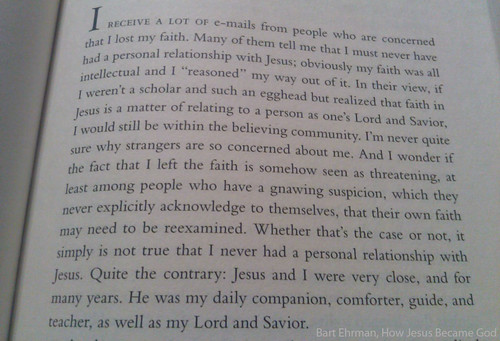
Just before Easter this year, I heard an interview on Fresh Air with historian Bart Ehrman on his latest book, How Jesus Became God. It was a fascinating interview, which piqued my interest in early Christian history.

As an evangelical, I always felt a bit hazy on early church history. I tried to learn more about it, about what the earliest Christians were like and believed, but finding useful information seemed difficult. I couldn't find very much beyond legend in Christian media, and secular historians seemed hell-bent on destroying any evidence of truth. Aside from the Acts in the Bible, I didn't really know much at all about early Christianity or how the Bible was put together.

I remember sharing this concern with a pastor friend of mine. I wanted to know how the Bible as we know it today became the canon, and why it happened so late after Jesus' life. I knew it was roughly the fourth century, but I was hazy on who and how. To be honest, it really bothered me that a bunch of Roman Catholics (pre-Martin Luther, which meant to my Protestant mind, a very dubious group of church leaders indeed) seemingly sat down and picked and chose which books "fit" and which ones didn't. I could believe that the Holy Spirit directed them to decide which to choose, but I also could conceive of men "misinterpreting" the Holy Spirit and making mistakes. My pastor friend gave me a book he assured me would help me understand how the books of the Bible were chosen.

I read a chapter of the book and put it down. It made no sense to me, was overly academic and really wasn't assuaging my doubts. From then on, I just sort of allowed myself to forget about it. I allowed it to be one of the few intellectual things I'd simply not pursue and let faith in past knowledge and expertise reign. I wasn't one to do that generally; I like to understand how things work and how things came to be and form my own opinions. But this subject was just too deep - and too treacherous - for me to delve any further into.

The NPR interview with Ehrman, a professor of religious studies at the University of North Carolina, Chapel Hill, re-sparked my interest. His newest book, the one he was being interview about, explained how the earliest followers of Jesus likely viewed him as the Messiah in an earthly sense - the literal king of the Jews - but upon believing he had risen from the dead, began to believe he was greater than that. This isn't in and of itself entirely foreign to a Christian believer, but what was fascinating is how the early Christians developed their theology of Jesus. From believing he had been adopted as Son by God upon his death and resurrection, to believing he'd been God incarnate in Mary's womb, to believing he was God before time, the belief in who Jesus was grew and morphed and became increasingly more sophisticated as time - and the educational levels of believers - went on. He uses the New Testament as his primary evidence of these theological changes, using the Gospels and Paul's letters to show the chronological changes in these beliefs through the NT books themselves. I'd read the Gospels countless times, but never realized until he pointed them out, how different each Gospel is - and particularly how different the Gospel of John is, the latest Gospel authored.

But I'm getting ahead of myself. After listening to the interview, I went to order the book. However, it was not yet released at that time, so I ordered one of his older books first, Misquoting Jesus. This book turned out to be the perfect starting point for my studies. It explained how the manuscript we call the Bible today came to be - the very question I'd been wanting answered for years. While it didn't go as late as the Council of Nicaea who eventually formed the canon, it did explain where all the earliest manuscripts came from, and how those manuscripts got copied and distributed. What struck me the most was the fact - one I'd never even heard before - that we don't actually have any of the original manuscripts. Not one. All we have are copies, which were likely copies of copies, if not copies of copies of copies. And of all the copies of each book or letter of the New Testament that are available to scholars today, most of them don't even match each other. Some bear only slight mistakes - spelling, a changed word - but some actually have entirely different sections added or subtracted. Since there is no way of knowing which copies were copied from the originals and which were copied from changed copies, we have no way of knowing what the originals even said.

Furthermore, the originals were not even penned until, at the earliest, twenty years after Jesus' death. The earliest letters of Paul were written twenty years later, and the Gospels were written even later than that, the earliest Gospel Mark being written approximately forty years later and John near the end of the first century, about sixty years later. These were things I'd never known before.

Misquoting Jesus was a good precursor to How Jesus Became God. It laid the foundation of textual criticism which gets touched on in HJBG. Both books were incredibly enlightening. I know I'd never have been able to read them as a Christian; they'd have come across as more secular Christian history bashing. Except for one thing. One thing that would have bothered me deeply.

Bart Ehrman was once an evangelical himself. He attended Moody Bible Institute and all.

It was through his study of early church manuscripts and texts that he developed a more "liberal" view of the Bible, seeing it as a very "human" book instead of the inspired word of God. It wasn't this by itself that eventually led to his agnosticism, but it played a large part. Knowing this about his personal history gave these books more credibility to me. He is not a "militant atheist" out to destroy any chance that the Bible might be true. He's a man who once believed in Biblical inerrancy and divine inspiration and who himself once had a "personal relationship with Jesus". He didn't go into the field of textual criticism to debunk Christianity; he went into it to strengthen it.

Bart Ehrman has written several books, and I'd like to get my hands on all of them eventually. The haze of early church beliefs has finally started to lift for me, as I see the Christian religion for what it really was - a fascinating religion that expanded in nuance through time and gained popularity through Roman politics.

Sunday, 27 April 2014

Conceal, Don't Feel


Like all things that get super popular super fast, the Disney movie Frozen has started to receive its inevitable backlash. People are finding all the plot holes, like the dodgy parenting and crazy acts of a crazy sister. And of course, people are sick of the songs, like "Let It Go" in particular.

But you know what? I loved the movie. And I love "Let It Go". And here's why.

First, let me state that I think it's just an adorable movie. It's entertaining, the characters are charming, Idina Menzel rocks my world and has done since playing Maureen in RENT. It's a kids' movie, so I don't worry much about why on earth a couple of parents would think it was wise to lock a kid up rather than teaching her how to control her powers. I love the message at the end that a) you don't need a man to save you and b) the act of true love that saved her was committed by her own love for her sister. Come on, it's a great message.

I just love it.

"Let It Go" is a great song. It's got all the Disney/Broadway key elements to it - passion, emotion, a a riveting crescendo, Idina Menzel. It's not about lesbianism (though even if it was, I'm cool with that) but about freeing oneself from the conformity forced upon them. In Elsa's case, it was the freedom to freeze a bunch of stuff without (she thinks) any retribution. And I suppose for a girl who realizes she's a lesbian, it's a song about the freedom to come out. (Though Elsa was not a lesbian. This just isn't in the movie. For me though, it's a song about letting go of religion.

I know I'm not alone in this. I know there are lots of other people who have been reduced to tears by the power of Elsa's words in this song in the context of "letting go" of the religious beliefs that they have been conforming to for years. I'm just going to go through this song, emboldening the lyrics that really touch me, and if necessary (though I'm sure you're smart enough to get the connections) adding some commentary on how it makes me feel in that context. Keeping in mind the song IS about freezing stuff, so you know, the "snow" would have to become metaphorical, which is actually still a pretty good metaphor for someone feeling stuck in a belief system and culture they can no longer accept for themselves. It's a pretty frozen place to be.

The snow glows white on the mountain tonight
Not a footprint to be seen.
A kingdom of isolation,
And it looks like I’m the queen.

The wind is howling like this swirling storm inside,
Couldn’t keep it in, heaven knows I tried


[Heaven KNOWS I tried. I tried for YEARS to contain the storm that was swirling inside me. Knowing I didn't really believe any of this anymore but refusing to accept it. I tried so hard, but eventually, I just couldn't bear the storm inside me any longer.]

Don’t let them in, don’t let them see,
Be the good girl you always have to be.
Conceal, don’t feel, don’t let them know,


[I wanted to be that good girl I'd always been - the girl who lead worship at church, who knew the Bible intimately, who spoke up at Bible studies and prayed out loud, who loved people and reached out to them. I didn't want anyone to know I wasn't that girl anymore.]

Well, now they know!

[Actually not too many know yet. Word is getting around though.]

Let it go, let it go
Can’t hold it back anymore,

Let it go, let it go
Turn away and slam the door!

I don’t care
What they’re going to say
Let the storm rage on,
The cold never bothered me anyway.


[I'd like it not to bother me, that is. It actually does.]

It’s funny how some distance
Makes everything seem small
And the fears that once controlled me
Can’t get to me at all.


[It's true. The further I get from it, the less I worry about it. The less I'm afraid of "hell", the less I'm worried about how people will treat me, the more I realize just how ludicrous Christianity, and all religion, is. Particularly poignant is how the "fears that once controlled me can't get to me at all" is - the threat of hell is horrifying and paralyzing, but the further away I get from it, the more I see it for what it is: manipulation.]

It’s time to see what I can do,
To test the limits and break through.
No right, no wrong, no rules for me,
I’m free!


[Without religion telling me what's right and wrong, I can finally accept what my heart has been telling me for years about right and wrong. Technically, without religion there is no actual "right and wrong"; that doesn't mean however that non-religious people have no morals. We are just willing to use critical thinking and humanitarian principles to inform what is ethical and fair. Like letting gay people get married.]

Let it go, let it go,
I am one with the wind and sky


[Sounds silly, but now that I see myself as a evolutionary development, I do feel more connected to the earth. We sprang from the earth, and we will return to the earth. It's kind of an amazing thing.]

Let it go, let it go,
You’ll never see me cry.

[Not true. But wouldn't it be nice if it were?]

Here I stand
And here I'll stay.
Let the storm rage on...

My power flurries through the air into the ground,
My soul is spiraling in frozen fractals all around,
And one thought crystallizes like an icy blast
I’m never going back,
The past is in the past!


[Can I get a non-religious AMEN to that?! It's the most freeing thought that I'm NEVER going back - the past is in the past!! Here's hoping I have at least another thirty years on earth to make up for the thirty years I lived in ignorance!]

Let it go, let it go,
And I'll rise like the break of dawn.
Let it go, let it go,
That perfect girl is gone.


[I don't have to be perfect! I can make mistakes! I will do my best as always to keep being the best me I can be, but now, I don't have a cosmic finger wagging at me every time I screw up or a book of rules to point out how supposedly broken I am inside. That perfect girl is gone; she left nothing but normal old me behind. Yes!]

Here I stand
In the light of day.

Let the storm rage on!
The cold never bothered me anyway.


[One day, one day soon, I'll stand in the light of day as an agnostic atheist. I'm still working on finding that courage within me.]


For so many years, I had the same Elsian (new word?) philosophy: Conceal, Don't Feel. "Put on a show; make one wrong move and everyone will know."  I concealed, not so much to myself or even to "God", but to everyone else, my doubts. I refused to feel how my doubts made me feel. Any time I allowed my feelings to spill over, I was drowned in my own tears, and drained afterwards from the emotional and mental distress. Losing my faith was utterly the most painful experience of my life. Having to conceal it so no one would know was exhausting. Keeping it to myself, refusing to feel it, refusing to "let it go" was isolating, like being locked in a dungeon all alone. The fear of what would happen if I "let it go" (aka hell) was more than I could bear.

Like Elsa, once I let go, everything changed. Even though she went through a rocky period before knowing how to "let it go" under control, she experienced freedom for the first time when she just let all that power explode around her. I know how Elsa felt, letting the storm rage on. It felt glorious.

Sunday, 13 April 2014

The Capital G

Another thing that's been annoying me... The letter G.

I've been coming up against this problem constantly in my book that I'm writing. You see, I'm a bit (a lot) of a grammar nerd. (Don't judge me now if you find a mistake or two - trust me, if I see a mistake, even if it's years old, I will EDIT that shit.) I appreciate the proper usage of grammar but can totally appreciate improper grammar if there is proper intent for the misuse.

So, God. Or god?

I have always referred to the Christian God in print and in thought with a capital G. It is not just correct usage to capitalize the first letter of a proper noun, it is also acceptable when emphasizing the singularity or ultimateness (totally not a word) of the noun in question. In the instance of the Biblical God, from a literary standpoint, the capitalization works both ways. The book maintains that this is not only his name, but that he is the ultimate, supreme "God".

Furthermore, the capital letter signifies reverence. Christians capitalize God to illustrate his Holiness and Sovereignty above all things.

It always annoyed me when people, believers or non-believers, referred to God as god, not just because it was irreverent but because it seemed grammatically incorrect. It was a proper name, and it reflected his One True Godness. Thus the capital letter. Like calling my mom Mom, my One True Mom. (Those were intentional sentence fragments, by the way. Fragments are unacceptable in formal writing but acceptable when intentionally spoken colloquially. I mention this, because the moment one claims to be a grammar nerd, all the other grammar nerds rush in to prove that they are nerdier. I am pointing out my intentional errors to justify them before the Holy Judgment Seat of Fellow Grammar Nerds. You must know the rule in order to break the rule is my favorite rule.) I also refer to Allah with a capital A and Zeus with a capital Z (to get back to the subject).

I no longer attribute ultimateness (there really should be an actual word for this) to the Christian God, so no longer do I feel the need to unnecessarily capitalize pronouns like "He" when referring to "Him", which was always pretty questionable from a grammatical standpoint anyway. But what about the name "God" itself? Should it still be capitalized?

I'm thinking of it like this:

1. It is extremely unlikely that there is actually any kind of "God" with a capital G - that is to say, an over-ruling singular God above gods, a one Power that oversees all power in the unknown expanses of this universe and all other universes and all other unknown others. So to attribute to the word "god" a capital letter is incorrect, because such a being doesn't exist. It is incorrect unless I'm referring specifically to the possibility of such a God existing, in which a capital letter might actually be literarily valid. It would be similar to my capitalizing Power in that first sentence; it would be an emphasis on its supremacy. Like absolute Truth or the concept of True Love or some other Dickinsonian capitalized attribute.

2. When referring to the Christian God, it is understood that the capital letter refers to God being God's name, "God" here being an actual being or literary character, like Zeus or Athena. It would be grammatically incorrect to write Zeus as "zeus" or to refer to me as "lori". Even my spell checker is giving me angry red squiggle lines for not capitalizing those two proper nouns. So in reference to this Biblical character, a capital G is legitimate.

3. Yet the very act of a writer taking a common noun like "god" and attributing to it a capital letter implies that the writer gives credence to that noun's supremacy, that this particular god deserves the name God, as if one church deserved to be recognized as the Church or one broccoli on my plate deserved to reign as the one supreme Broccoli. It seems to accept that belief that one specific god deserves the title God. That annoys me.

4. But to refer to the Christian God with a lowercase g annoys me in a grammatical and literary sense. Using Allah as an example, "Allah" simply means "God" in Arabic, but to call him allah seems to be the same as saying zeus or lori. It's still a name, even if it's a presumptuous one. Therefore when referring to the Muslim Allah as with the Christian God, surely the correct rule would be to use a capital letter. It goes back to being a proper noun, even if it is usurping a common noun in doing so. Yes, it's annoying that it allows the connotations of Holiness and Sovereignty to creep into the meaning, but the alternative would be fairly inaccurate grammatically. GAH!!!

If you've borne with me thus far, you'll (maybe) understand my (completely unimportant) conundrum. To capitalize or not? I think in practicality it turns out looking something like this:

The god of the Bible liked to destroy stuff.

Then God said, "Let there be light", which is how we got light.

I used to be mad at God when I thought he had abandoned me, but then I realized there was never any god in the first place. God never abandoned me, because that god never existed.

Totally cleared up now, yeah...?

Friday, 11 April 2014

Morally Opposed, Legislatively In Favor?

I have to say, I'm really appreciating this new blog I've started. I've been writing on my personal blog for over ten years now, but somehow, the things I have to say these days are easier to say in a separate place, away from the "me" people have come to know. Scott thinks I should just amalgamate the two and say what I want to say all in one place. But there's freedom here, and a little anonymity, and if it takes stepping out in tiny baby steps like this before I can really be open about my feelings and thoughts, then it's what I have to do.

I have always steered clear from political issues on my personal blog. Partly because up until lately, I've never cared too much about politics and wasn't very informed on issues. Since moving back to the US, both me and my husband have taken a renewed interest in politics. A lot of it has to do with the novelty of it; the United Kingdom has an interesting political system with multiple parties, but in Scotland, politics were boring to discuss - everyone votes Labour. Well, until a few years ago, when the Lib Dems took a lot of Scottish votes away from Labour. And things are cooking up in Scotland right now anyway with the referendum for independence coming up this fall. Politics were just starting to get interesting when we moved back to the US.

My entire family is Republican. While I can't identify completely with the Democrats, I can identify with them a whole lot more than the Republicans. Democrats are centrists, even slightly right leaning, in UK terms. Republicans are next door neighbors to the far right fringe end of the Conservatives and the Tea Party? BFFs with the fascist BNPs.

All that to say, for a British citizen (Scott) and a former British resident (me), being Democrat is pretty rational.

(Yes, there are other independent parties in the US. Unfortunately, the US two party system barely allows for these independent parties to get any recognition. And unfortunately, most of these independent parties are utter loonies anyway. I do hope for a day when the two-party system can open up like the British system to allow seats in Congress and even perhaps the Presidency to be held by a number of non-Republican, non-Democratic, new party leaders.)

(Even if that means a looney gets a seat.)

Anyway, I had a point when I started writing here, which I have veered a nice little ways away from it. I came here talk about same-sex marriage.

So, I've never had a major problem with gay people or gay marriage. All the years I was a Christian, I believed the homosexual lifestyle was wrong, but if someone wanted to live it, it didn't affect me at all. It wasn't my problem or my concern. I believed people were born with a "tendency" towards being gay, but that God could "deliver" them out of it, much like people born with tendencies toward alcoholism or violence could be delivered. When asked about it, I was truthful that I believed it was a sin, but that was between them and God, and really had very little to do with me, unless you personally wanted my prayer. Furthermore, I never went so far to say that gay people were going to hell, just that their actions displeased God. But we all displease God with our actions, we are all sinners, and I didn't see the sin of homosexuality to be any different than my own sins of gossip, occasionally drinking too much, and pride. A gay person could be a Christian, albeit a deceived one, but still eligible for salvation, as far as I could tell.

So even in my evangelical days, if someone asked what I thought about same-sex marriage, my answer was always, "I don't." Just let them get married. What's the big deal? It doesn't affect me.

This stance began to change though. Over the years, as the subject gained greater media and societal attention, I observed the pain that the debate, and the issue of homosexuality itself, was causing my gay friends. I had friends who had to choose between their careers in the military or happiness with the love of their lives. I saw friends cut off from their families and/or communities. People I knew, friends, even extended family members were being heralded as immoral, licentious, shameless degenerates on the sole grounds of who they loved. While from a Biblical standpoint, I still couldn't say it wasn't sinful, I was very certain they were entitled to the same rights as anyone else, and absolutely did not deserve to be hated, attacked, treated as lepers or burned at the stake like the Salem witches (who also didn't deserve such a fate). I heard careless, flippant comments by straight people complaining that they didn't get any special rights or attention for being straight, that they didn't feel the need to declare to the world their sexual orientation, so why did "those people" feel the need to?

Because you don't have to declare anything. You can hold hands with your husband and your two-point-five biological children in public and not receive a second glance. You have the luxury of silently declaring your sexual orientation every day in everything you do with zero retribution. You don't need special rights or attention, because you already have them.

Why do homosexuals feel the need to "declare" their sexual orientation? Could it be because they have spent years, if not decades, pretending to be something they are not, being bullied by the peers and castigated (quite possibly physically) by their parents and other adults, and just want to finally break free from all that bondage? Or perhaps, maybe some of them are actually "declaring" nothing. Maybe they are just walking hand and hand like you are, but you see that as flaunting something, declaring their sexual orientation, when really, they are just quietly living their everyday lives.

Either way, I realized my "live and let live" stance wasn't going to cut it. No one's was. If I wanted to see equal rights for all law-abiding people, it was going to take an actual stance. A pro-same-sex marriage stance.

This, of course, conflicted with my religious beliefs to an extent. I started defining my position as "morally opposed but legislatively in favor". As my faith slowly disintegrated, this stance disintegrated with it, into simply "in favor", for the supposed immorality of it had been tightly intertwined with religion and nothing else. However, the "morally opposed but legislatively in favor" is the position I wish more evangelicals took.

It's impossible - actually, no it's not impossible, it's just difficult - for an Evangelical Christian, or a member of any religion that objects to homosexuality to look at it from a strictly human rights perspective. It's difficult, because Christians (in particular) believe they own the rights to marriage, or at least their religion does. They believe that God created marriage, and therefore God has the sole say on how it is administered.

(If this was true, why are Christians allowing members of other religions to marry each other? And why are they allowing divorce?)

God created marriage between a man and a woman, they maintain. Therefore marriage between a man and a man or a woman and a woman is against God's law.

Okay, fine, we'll grant you that belief. We'll even grant you the belief that homosexuals going against this plan are going to hell. You are welcome to believe that. "It's a free country", Americans love to say.

And that's the point.

It's a free country for you to think gays are going to hell. And it's a free country for gays to be gay. And therefore, it should be a free country for gays to get married.

Our country is not, despite what is touted through the right-wing media, a "Christian country". It was founded on freedom of religion, the freedom to believe or not believe whatever one wants. Our forefathers may have been primarily made up of deists and various brands of Christian, from Anglican to Unitarian, (though not all, Jefferson, for instance, had decidedly very un-Christian beliefs), but they were clear that this is NOT a "Christian" nation. America is not a theocracy. The Christian definition of marriage should not be the only definition in a country where freedom from such restraints used to be our crowning glory.

Christians and other religious people, or people simply anti-gay (I am purposely steering clear of the word "homophobic" because while it is a correct description for many anti-gay people, it isn't quite fair on all of them), have further reasons they use against same-sex marriage. They believe that it is detrimental to society and detrimental to children. I can only assume, since this was never a position I totally understood, that that is position comes from the stereotypical concept that kids need both a motherly mother and a fatherly father to get the balance right. While I rarely see that stereotype play out perfectly in even heterosexual marriages, I assume the assumption is that in same-sex marriages, kids miss out on one or the other.

The profound misconception here is that women always act like "women" and men always act like "men". Therefore, in a heterosexual couple, there are equal and opposite traits that culminate in a completely wholesome companionship.

This speaks to absolutely nothing of the truth or reality.

In heterosexual couples, you have women who can be described as having one or many of these stereotypically male traits: domineering, authoritarian, outspoken, unemotional, tough, competitive, sexually aggressive. Men can be described in stereotypically feminine ways: nurturing, gentle, soft-spoken, irrational, emotional, submissive, accepting. Some couples are so similar that there is hardly any opposing characteristics; both man and wife can be calm, gentle, soft-spoken, passive and nurturing with no authoritarianism, outspokenness, aggressiveness, or, say, confidence. Conversely, some couples are both domineering, assertive, loud, imposing, authoritarian, strict and judgmental, with no signs of gentleness, irrationality, softness or perhaps compassion. All of these are, of course, generalizations, but they hopefully get the point across.

Again, I'm speculating, but I assume the Father-Mother scenario assumes a give-and-take of masculine and feminine traits that round out a family. This is simply not the case in many, if not most, relationships.

And in homosexual couples, the scale isn't tipped the other way. Two women do not equal two emotional roller-coasters and door mats. Two men do not equal two dictators and workhorses. Same sex or different sex - at the end of the day, it's just two individuals coming together to form a partnership. Some are great matches, some are bad ones.

There is also that study that was in the media a while back, claiming that children with homosexual parents fared worse than children with heterosexual relationships. This would be compelling indeed, if the study had been a good one. As it turns out, it was a terrible study that pretty much just showed what we already knew - children from broken families fared worse than children with families intact. Turns out, it had pretty much nothing to do with whether the parents were gay or not, but still together or not.

So, in a few short words, yes, it's complicated. Sort of. It's extremely difficult to untangle oneself from the net of cognitive dissonance. It's easier to hold to the black and white than to sift through the many shades of grey (no reference to that awful book intended). But really, it's not a complicated matter. People should have the right to marry who they love, as long as both parties involved are consenting adults. It only gets complicated when people make it that way, trying to create slippery slopes and outlandish resulting outflows. (That's not to say deciphering all the possible outcomes is wrong. Legislation definitely needs to be written in such a way that it does not inadvertently allow for things that would be problematic.)

It may clash with your religious beliefs. You have the right to dislike it. But two total strangers getting married only affects you insomuch that you may possibly one day have to explain why Jonny has two mommies to your child. It does not creep into your marriage and defile it. It really has very little, if anything, to do with you at all.

But it means everything to the people who want to marry and can't, who want to express their undying love for each other by committing to a lifelong union, for better or worse, richer or poorer, in sickness and in health. Who want to know their best friend and soul mate will be cared for financially when they die through life insurance plans and inheritance. Who want to be parents, who want to be parents that raise their kids in a secure home, with family health care policies and legal custody for both parents, and no discrimination.

For you, it's about a religious principle and someone else's possible afterlife. For them, it's about basic human rights and their own quite literal, very tangible day-to-day experiences.

If affects you little. It affects them in every way. Isn't there a way to be morally opposed, but legislatively in favor?

Thursday, 10 April 2014

To Church Or Not To Church? That Is the Easter Question.

Easter Sunday morning.  I'd wake up to a bright sun shining through my lacy white curtains and Keith Green's "He Has Risen" turning on the record player.  Mom would be making pancakes, or cinnamon rolls - something special on this special morning.  I'd put on my brand new springy dress, one of the only times a year I wanted to wear a dress, and if it was still a little chilly outside (a March Easter, perhaps), a pair of soft white pantyhose.  I'd run down the hall to find my pink plastic basket in between my brothers' blue and green ones, all filled with green plastic grass and multiple multicolored plastic eggs, full of chocolate and jelly beans and Sweet Tarts.  After gorging on special breakfast and however many eggs my parents would let me open, the five of us would pack into the minivan and drive to church.  The church would be full of beautifully dressed little girls, some of us with white straw hats, and combed little boys in shirts too starched to be comfortable.  We'd sing joyful, boasting songs like "Up From the Grave He Arose" and listen to the glorious story of the man whom death could not defeat.  After church, we'd drive to my grandmother or my aunt's house for a huge family feast - all the cousins, uncles, aunts and grandparents would be there - and we'd hunt for even more Easter eggs, some plastic, some boiled and dyed (always a disappointment to find) in the large country yard before stuffing ourselves for the second time that day, only now with ham and deviled eggs.

If you grew up in America, and particularly if you grew up a Christian in America, this is a familiar scene from start to finish. While Easter was never as big to as Christmas, or even Thanksgiving, it was in the Top Three for exciting annual holidays.  Even as a child, getting the whole family together for a huge feast was the top reason I loved these holidays so much.  (Well, maybe it was in the Top Three reasons I loved them. Presents and chocolate were major factors too.)

As I got older, and the church calendar began to take on greater meaning for me, I started practicing Lent every year before Easter.  Lent was a deeply personal experience for me. I never attended a church that observed Lent, so I was pretty much on my own for figuring out what it was all about.  For many years I practiced it on my own, giving up a wide range of indulgences or vices, from chocolate or alcohol or meat to anger or shouting at my kids. Some years I even fasted on Good Friday.  Lent was a time of recognizing my shortcomings as a human, acknowledging my sinful nature, and finally rejoicing on Easter Sunday in my salvation from my broken and helpless state.

When my kids came along, we started up the secular traditions of Easter too - rolling eggs down a hill, egg hunts, Easter baskets and the confused Easter Bunny who for some reason lays eggs instead of giving birth to live young like all other honest, hardworking mammals. I continued my personal favourite Eastertime tradition of getting a new dress, for myself and for my two darling, sugary sweet daughters. And of course, we always went to church and sang "Up From the Grave He Arose", and when I remembered, I played Keith Green, no longer on vinyl but compact disc.

This is my first fully secular Easter.  Last Easter was complicated, as I was deep in the throes of confusion and doubt over my faith, but desperately holding onto belief in Christ and his resurrection with everything I could muster. I struggled through Lent last year, each day a reminder that I didn't fully believe anymore, as if I needed any more reminders tacked to my weary, conflicted heart. We rolled eggs down a hill on Easter morning, but the church service, as beautiful as it was, left me empty.  A year later, I'm now facing my very first Christian holiday as a confirmed agnostic, and I have no idea how to confront it.

Actually, that's sort of untrue.  Almost forty days ago, I faced Ash Wednesday and the start of Lent with a sad tug at my heart.  Observing Lent now meant nothing to me, but I missed it.  After wrestling with the concept for weeks beforehand, I decided I could practice Lent for personal reasons without including the spiritual aspects of it, but I couldn't stick it out.  Without the religious ties, Lent had no strength or power over my cravings, and I gave in after the first week.

I asked my husband what we would do for Easter.  He shrugged.  Having been raised in the United Kingdom in a church that didn't formally celebrate holidays, Easter involved some egg rolling and a slightly more built up Sunday dinner.  If he was lucky, someone would call out "Up From the Grave He Arose" for the congregation to sing, but it wasn't a given.

I told him I thought maybe we should just go to church.  It's Easter after all, what else does one do on Easter?  He didn't see the point.  I didn't either, but really, how else would Easter be Easter?  And getting down to brass tacks, if we didn't go to church, there would be no justification for a new dress!

Yes, if we're all honest about it, despite what we say is the "true meaning of Easter", consumerism, like pretty much all religious and non-religious holidays, is always going to be at the forefront.

Scott told me just to go buy new dresses if we wanted them.  And we'd do an Easter egg hunt and make baskets and such.

Without church, though, it seems, well, sort of a let down.  Rather anti-climactic.

None of this changes how I feel about church, however. The whole Jesus story is just a fairy tale now, like something I read in a children's book full of pink fluffy cloud illustrations and angels in white gowns with wings speaking with exclamation marks in word bubbles.  In fact, the church side of Easter, aside from the actual ritual of attending, irks me.  I realized just how much it irks me this morning when the young two kids and I went to the community library for Story Time, like we do most Thursdays.  The books were about Easter.  The first was a story about a little chick doing something inane and cutesy, and the second was about a little girl who lost her special Easter egg.  So far, so good.  Until halfway through book number two, when the little eggless girl explains what Easter is. "A man called Jesus came to earth to save all of us from our sins. But the people didn't like what he was saying and they killed him and put him on a cross.  However, three days later, the rock that was in front of his tomb had been rolled away and Jesus came back from the dead!"  She tells us that on Easter we go to church to learn about this man Jesus.

I didn't want to be that stereotypical anti-religious person who kicks up a fuss about religion being expressed to my children in the form of truth, so with great difficulty, I kept my mouth shut and my face smiling.  I did not manage to suppress a couple of deep sighs, though.  Luckily, a mother with a toddler and a five year old is allowed to sigh for any reason under the sun, so it wasn't noticed.  I looked around the room.  The likelihood is, most, if not all, these mothers, would be in total agreement with the story - in fact, grateful that the "true meaning" was being expressed.  I chalked it all up to part of living in a religious society, and at least it was Lolly who was hearing the story and not the Fifi.  Lolly has always been our resident atheist child, the one who told us when she was barely old enough to speak that Jesus was pretend, who has always refused to pray before meals or join the chorus of "amen"s after, and who recently told me with the decisiveness of a forty year old that "I am not a Christian" despite my never saying similar things to her. And Jaguar, well, he's not even two.  He just wanted to pull the books off the shelf.

It all comes down to this: I don't know what we'll do this Easter.  I have plastic eggs ready to fill and three baskets with plastic green grass.  I have new springy outfits for all of us, and will be bringing deviled eggs to the big family Easter lunch. We may go to church out for cultural reasons, or we might stay home and roll eggs down a hill (stone rolling away from the tomb associations aside).  I'm covering new ground here. Maybe in a few years we'll make our own traditions as we meet others like us.

No matter what we end up doing, however, I will never buy, nor can I understand why anyone, especially Christians, would ever buy, one of these.


Surely this is, like, six kinds of wrong?


You Can't Handle the Truth!

Being anything other than Christian in the Bible Belt is a little like trying to walk a tight rope suspended above an enclosure of tigers. Admittedly it depends on where in the Bible Belt you are - some cities are more tolerant than others - but where we are, it's pretty 'ropey' to be non-religious, and even worse if you are a confirmed agnostic or atheist. Though it's never happened to anyone I personally know, I've heard horror stories of people losing their jobs over their (lack of) faith and being ostracized by their community. Keeping our opinions to ourselves, in not only religion but also politics, has become our modus operandi. My husband doesn't talk about religion or politics at work, and I don't talk about them with other mothers at soccer practice or play groups. It's a little isolating, but it's what we do to survive. I imagine the small population of people with religious beliefs aside from Christianity or political affiliations aside from Republican feel the same way. (I remember me and my entire class shunning a girl on the playground in elementary school because her family was voting for Michael Dukakis instead of George Bush back in the 1988 presidential election.)

It's not that I'm ashamed of my new-found unbelief. It's more that to be an unbeliever is akin to being unvaccinated. It's as if people have this fear that if they come in close contact with an unbeliever, some of their unbelievingness might infect them, or at least infect the more vulnerable members of society. If an unbelieving child plays with their believing children, they might pass on some kind of doubt-bacteria which could start an epidemic. Christianity has practically eradicated atheism and agnosticism in the South; no one wants those few unenlightened families to interfere with the herd. Generally speaking, folks tend to have two reactions to someone who doesn't agree with their religious beliefs - proselytize or ostracize. (There are of course those wonderful people who choose to live and let live, for whom I am incredibly grateful.)

I'm not a rock, I'm not an island, so I do worry about being alienated. I grew up in this town, even though I lived elsewhere for fourteen years. I returned to this area a very different person than the young girl who left it. When I run into people who knew that girl, it's uncomfortable to reveal the woman I have become. So, it's not surprising what I said a few days ago to the dentist.

In all my thirty-plus years, I've never had a cavity. Until this year. So last week I went to my dentist's office for my first filling ever. I've known my dentists for most of my life. They are father and brother to the kid who was my best friend for many years. When we returned to the area, we chose their practice, because they are fantastic at what they do, and I know and trust them. While I reclined in the chair, waiting for the anesthetic to kick in, the senior dentist, my friend's father, came in to say hello, catch up a little on the fourteen years we've been away.

He asked about my parents, asked about my brothers.  I asked about his wife, his son. I asked if he was still at our old church.  He asked me where we are going to church.

I guess I sort of asked for that.

And at the moment of truth, I wimped out.  "We're going to the Lutheran church," I answered.

I was surprised by my response. It wasn't a complete fabrication; it is the church we were visiting as a last ditch effort to recover some sort of mustard seed of faith before realizing we just flat out did not buy into it anymore.  But it's not the church we attend. We don't attend anywhere.

The answer satisfied him, and we moved on.  But I kept thinking about what I'd said, about  how hard it is to admit being non-religious.  I could imagine the look on his face if I'd told the truth.  Which would it be, a millisecond of sadness, disappointment or disapproval before reverting to medical professionalism? Would the conversation have become stilted, uncomfortable?

Maybe, just maybe, it would have been fine, but I know this place and its people, and I can say pretty confidently that there would have been at least a little sadness in his eyes. It's hard for a Christian to see one of its sheep wandering, ignoring the shepherd's voice, leaving the flock.  It's not only hard because they worry about that sheep's eternal soul, but it conflicts with their understanding of the shepherd.  Why wouldn't the shepherd leave the flock in search of the lost sheep?  It must be a problem with the sheep, not the shepherd.  It's never a problem with the shepherd.

At the end of the day, my response was probably the most prudent one I could have given.  I hate being dishonest with others, untrue to myself, but I'll put both my hands up in the air and admit that on most days it's better than being pitied or rejected.